
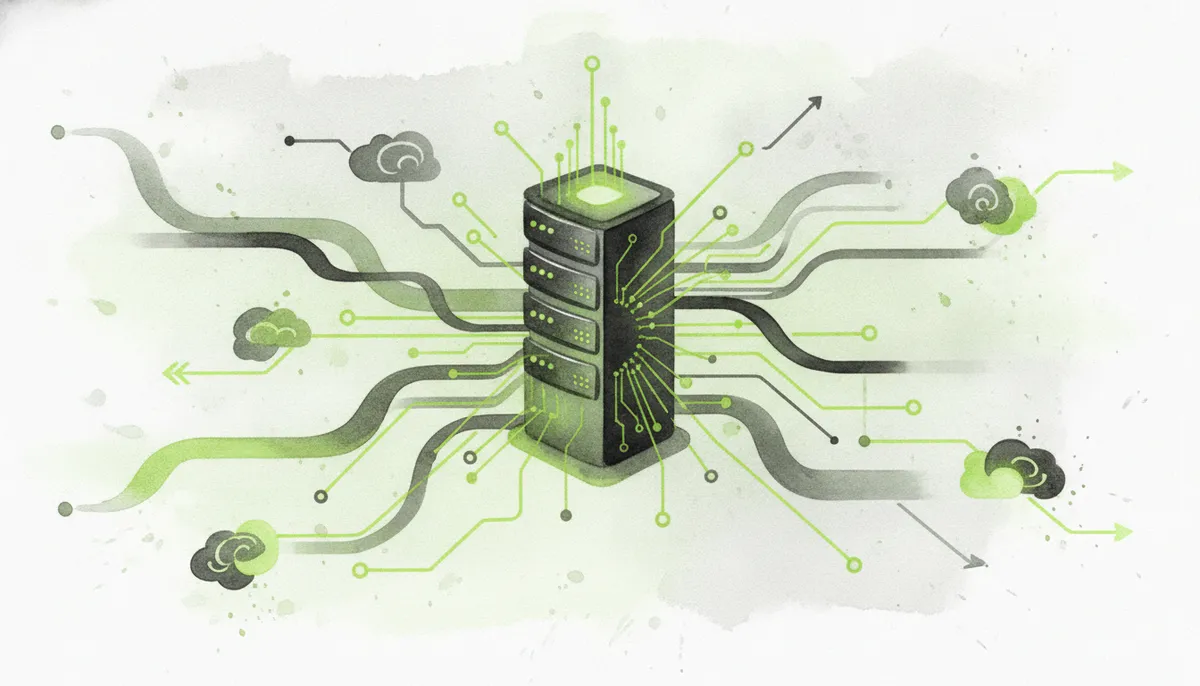
An MCP server, or Model Context Protocol server, is a centralized system designed to manage and feed contextual information to AI models. For SaaS founders, it standardizes how data like user history and brand guidelines are passed to AI, ensuring more accurate, personalized, and cost-effective outputs while preventing vendor lock-in.
An MCP server implements the ‘Model Context Protocol,’ an open standard for structuring and transmitting relevant background information to large language models (LLMs). This server acts as a crucial intermediary, gathering data from various sources (like your CRM or database), formatting it according to the protocol, and delivering it to the AI alongside a user’s prompt. This process ensures the AI’s response is not only accurate but also deeply personalized and consistent with your brand voice.
- What is a Model Context Protocol (MCP) Server?
- How MCP Servers Supercharge Your AI Marketing Stack
- MCP Server vs. Traditional Context Management: A Head-to-Head Comparison
- The Strategic Business Advantages of MCP for SaaS Founders
- Getting Started: How to Implement an MCP Strategy in Your Platform
- How MSH Can Help
- Frequently Asked Questions
- Is MCP the same as a vector database?
- What is the difference between an MCP server and RAG (Retrieval-Augmented Generation)?
- Do I need an MCP server if I only use one AI model?
- How does an MCP server handle data privacy and security?
- What programming languages or frameworks are used to build MCP servers?
- How can MSH help my company with an MCP server?
- Sources & Further Reading
- Written By
Key Takeaways: Understanding MCP Servers in 2026
- Definition: An MCP server implements the ‘Model Context Protocol,’ an emerging open standard for managing and passing contextual information to AI models. It is NOT the outdated ‘Master Control Program’.
- Core Function: It acts as a centralized hub to gather, structure, and feed relevant data (like user history, brand guidelines, conversation logs) to AI, ensuring more accurate, consistent, and personalized outputs.
- For SaaS Founders: MCP technology is key to avoiding AI vendor lock-in, enabling seamless switching between models from providers like Anthropic, OpenAI, or Google.
- Marketing Impact: In AI marketing, MCP servers power hyper-personalization at scale for outreach, SEO content generation, and automated customer interactions, directly impacting conversion rates.
- Business Benefits: The primary advantages are significant reductions in AI operational costs (via efficient token usage), improved model performance, and enhanced data security by controlling the context layer.
- Strategic Imperative: As of 2026, adopting an MCP-like architecture is becoming a standard for SaaS companies looking to build a scalable, efficient, and future-proof AI stack.
As a SaaS founder in 2026, you’re likely leveraging AI to drive growth, from personalizing marketing outreach to automating customer support. But as your AI usage scales, you’ve probably encountered the challenges: inconsistent outputs, skyrocketing API costs, and the looming threat of being locked into a single AI provider. The solution lies in a piece of infrastructure that is rapidly becoming the backbone of modern AI stacks: the MCP server.
Understanding what an MCP server is and how it functions is no longer just for engineers; it’s a strategic imperative for founders. This guide will break down the technology, its impact on your marketing stack, and the concrete business advantages it offers, providing a clear roadmap for implementation.
What is a Model Context Protocol (MCP) Server?
At its core, an MCP server is the engine that solves the biggest problem in applied AI: context. AI models are incredibly powerful, but without the right background information, their responses can be generic, inaccurate, or off-brand. An MCP server standardizes and automates the process of providing this crucial context, making your AI applications smarter and more efficient.
Deconstructing ‘Model Context Protocol’
To fully grasp the concept, let’s break down the name itself:
- Model: This refers to any large language model (LLM) or generative AI model you use, whether it’s Claude from Anthropic, GPT-4 from OpenAI, or Gemini from Google.
- Context: This is the critical background information the model needs to perform a task effectively. It’s not just the immediate prompt but a rich collection of data, such as brand voice guides, past customer interactions, target audience personas, or real-time user data.
- Protocol: This is a standardized set of rules for formatting and transmitting this context to the model. The protocol ensures consistency, guaranteeing that no matter which model you’re using, it receives the information in a structured, optimized way.
Think of it like this: An MCP is a universal ‘briefing document’ format for AI. Every AI gets the same high-quality, comprehensive set of instructions every single time, eliminating guesswork and improving performance.
The Role of the ‘Server’ in the MCP Architecture
The ‘server’ is the functional piece of infrastructure that brings the protocol to life. It’s the engine that runs the system, performing several key tasks:
- Ingests raw data from various sources like your CRM, product database, analytics tools, and content management system.
- Processes and structures this disparate data according to the MCP standard, often using techniques like Retrieval-Augmented Generation (RAG) to find the most relevant pieces of information.
- Serves this perfectly formatted context to the AI model alongside the user’s request.
This architecture decouples context management from your core application logic. Your app simply makes a request, and the MCP server handles the complex task of assembling and delivering the necessary background information, making your entire AI stack more modular and scalable.
Why MCP is a Foundational Standard for AI in 2026
The early days of AI development (2023-2025) were a Wild West of proprietary, ad-hoc methods for handling context. Each application had its own custom, often brittle, way of cramming information into a prompt. This led to massive inefficiencies, high maintenance overhead, and difficulty switching between AI models.
Standards like MCP, championed by forward-thinking organizations, address the growing need for interoperability in a multi-model world. For SaaS businesses, this standardization de-risks AI investments and dramatically accelerates the development of more sophisticated, reliable AI-powered features. Adopting this approach is a core part of building a mature and effective AI consultancy strategy.
How MCP Servers Supercharge Your AI Marketing Stack
For SaaS marketing teams, the gap between the promise of AI and the reality of its output often comes down to context. An MCP server bridges this gap, transforming generic AI tools into highly effective, brand-aligned marketing engines.
Achieving True Hyper-Personalization in Outreach Automation
Generic, automated outreach emails have abysmal response rates. Hyper-personalization is the key, but it’s historically been impossible to scale. An MCP server changes that.
It can automatically pull a prospect’s recent LinkedIn activity, notes from your CRM, and data on how they’ve interacted with your website. It then packages this rich context for an AI copywriter to generate a highly relevant, non-generic outreach email that feels personal and timely.
- Example: Instead of, “Hi [Name], I saw your company…”
- MCP-Powered AI generates: “Hi John, congrats on the recent funding round. I saw your post on LinkedIn about scaling your sales team, and our platform directly addresses the bottleneck you mentioned…”
As research consistently shows, personalized calls-to-action convert significantly better than generic ones. An MCP server automates the creation of this deep personalization at a scale previously unimaginable.
Enhancing SEO Content Strategy and Generation
A common complaint about AI-generated content is that it lacks brand voice, strategic nuance, and internal consistency. An MCP server solves this by feeding the AI a standardized context package containing:
- Your brand’s detailed style guide and voice principles.
- Core business topics and value propositions.
- Your top-performing articles to use as stylistic examples.
- Your target keyword strategy and semantic keyword clusters.
This ensures every piece of generated content, from a blog post to a landing page, is on-brand, internally consistent, and optimized for your specific SEO goals, helping you find the best SEO tools for your small business.
Streamlining AI-Powered Analytics and Reporting
When you ask an AI to analyze marketing campaign results, context is everything. Without it, you get a simple summary of the data. With it, you get strategic insights. An MCP server can provide the AI with the campaign’s original goals, target audience, budget, and historical performance data for similar campaigns. This allows the AI to move beyond summarization (“The click-through rate was 2%”) to strategic recommendation (“This campaign’s CTR was 15% below our Q1 average for the EMEA segment, likely due to headline A/B test underperformance. Recommend reallocating the remaining budget to the APAC segment where CTR is 25% above average.”).
MCP Server vs. Traditional Context Management: A Head-to-Head Comparison
The benefits of an MCP server become even clearer when compared to older methods of managing AI context. The ad-hoc approach of stuffing context into every API call is inefficient and doesn’t scale.
| Feature | MCP Server | Traditional (Stateless) API Calls | Custom In-House Solution |
|---|---|---|---|
| Context Management | Centralized & Standardized | Ad-hoc & Repetitive | Siloed & Brittle |
| Model Agnosticism | High (Plug-and-Play) | Low (Requires Re-engineering) | Very Low (Tied to one model) |
| Development Overhead | Low (Leverages Standard) | High (Constant Reinvention) | Extremely High (Build & Maintain) |
| Cost Efficiency | High (Optimized Token Use) | Low (Sends redundant context) | Variable (Often inefficient) |
| Scalability | Designed for Scale | Difficult to Scale | Can be scalable, but costly |
| Data Governance | Centralized Control | Fragmented | Centralized but custom-built |
The Strategic Business Advantages of MCP for SaaS Founders
Beyond the technical efficiencies, adopting an MCP server offers profound strategic advantages that directly impact your company’s bottom line and competitive positioning.
Future-Proofing Your Tech Stack by Avoiding Vendor Lock-In
The AI model landscape is incredibly volatile. The best, most cost-effective model for a task in 2026 might be obsolete by 2027. If your entire application is hard-coded to a specific model’s API, switching is a nightmare.
An MCP architecture abstracts the context layer away from the model layer. This allows you to swap out the underlying LLM—from OpenAI to Anthropic to an open-source model—with minimal code changes. This agility gives you a significant competitive advantage, allowing you to always use the most powerful and cost-effective tool on the market and maximize the ROI of your tailored AI solutions.
Drastically Reducing AI Operational Costs
A large, often hidden, portion of your monthly AI bill comes from the tokens used for context, not just the prompt and the final output. Every time you send a large block of text as background, you pay for it.
MCP servers are designed for efficiency. They use intelligent techniques like context caching, data compression, and precise retrieval to send only the most essential information with each request. This directly translates to lower monthly bills from your AI provider, improving the profitability and viability of your AI features.
Improving AI Model Accuracy and Consistency
The old adage “garbage in, garbage out” has never been more true than with LLMs. The quality of an AI’s output is directly proportional to the quality of its input context.
By standardizing how context is formatted and delivered, you eliminate a major variable in model performance. This leads to more predictable, reliable, and accurate results for your users. As numerous studies on LLM performance have shown, providing well-structured, relevant examples and context (a technique known as few-shot learning) dramatically improves task accuracy compared to simple zero-shot prompts.
Ready to build? Architecting a scalable MCP server requires specialized expertise. If you want to accelerate development and ensure your AI stack is built for growth, our AI web development services can provide the blueprint and engineering power you need.
Getting Started: How to Implement an MCP Strategy in Your Platform
Integrating an MCP server into your SaaS platform is a strategic project, not a simple plug-in. Here’s a high-level, three-step approach to get started.
Step 1: Audit Your Existing Data Sources
First, you need to understand what context you have and what you need.
- Identify all potential sources of context within your business: CRMs (HubSpot, Salesforce), product usage databases, customer support platforms (Zendesk, Intercom), and content repositories.
- Map out what specific contextual data is needed for each AI-powered task in your marketing and sales funnel. For example, email outreach needs CRM data, while a support bot needs help-desk tickets and knowledge base articles.
Step 2: Choose Your Implementation Path (Build vs. Buy)
Once you know what data you need, you must decide how to build the server that will manage it.
- Build: Utilize powerful open-source frameworks like LangChain or LlamaIndex to construct your own custom MCP server. This path offers maximum flexibility and control but requires significant, specialized engineering resources.
- Buy/Integrate: Look for managed MLOps platforms and AI infrastructure tools that offer context management as a service. These solutions can accelerate deployment and reduce the ongoing maintenance burden.
- Consult: Engage with expert AI consultancies like MSH to design and implement a bespoke MCP architecture. This approach ensures your solution aligns perfectly with your business goals and integrates seamlessly with your existing tech stack, providing a clear path to achieving custom AI for business growth.
Step 3: Integrate and Test Incrementally
Don’t try to boil the ocean. Start small and validate the approach.
- Select one high-impact, measurable use case, such as personalizing your automated sales outreach sequence.
- Implement the MCP server for this single workflow. Measure the impact on key metrics like open rates, reply rates, and meetings booked.
- Validate and expand. Once you’ve proven the value and refined the process, incrementally roll out the MCP architecture to other parts of your SaaS platform, like your AI content generator or in-app support bot.
Need a strategic partner? Choosing the right implementation path is critical. To avoid costly mistakes and ensure your architecture is scalable and secure from day one, book a free audit and our AI architects will help you map out the optimal strategy.
How MSH Can Help
Navigating the complexities of modern AI infrastructure can be daunting for a growing B2B SaaS company. If you’re trying to scale your AI-powered marketing features but are hitting walls with high costs, inconsistent model performance, and the technical debt of ad-hoc solutions, you’re facing the exact problem an MCP server is designed to solve. At MSH, we specialize in moving companies from chaotic, proof-of-concept AI implementations to robust, scalable, and efficient production systems.
Our end-to-end AI platform design services cover everything from initial strategy and data auditing to the architecture and deployment of custom infrastructure like MCP servers. We work with your team to understand your unique data sources, business goals, and existing tech stack to build a context management layer that not only saves you money but also unlocks new levels of personalization and performance in your AI applications. We don’t just deliver code; we deliver a future-proof AI foundation built for growth.
Curious how a bespoke MCP architecture could transform your AI marketing stack? Book a free audit with our AI specialists, and we’ll map out a clear, actionable plan tailored to your platform.
Frequently Asked Questions
Is MCP the same as a vector database?
No, they are related but distinct. A vector database is often a component of an MCP server. It’s used to store and efficiently retrieve relevant contextual information (via embeddings). The MCP server is the overarching system and protocol that orchestrates the entire context management process, which may include querying a vector database as one of its steps.
What is the difference between an MCP server and RAG (Retrieval-Augmented Generation)?
RAG is a technique, while an MCP server is the infrastructure that implements techniques like RAG. An MCP server often uses RAG as the mechanism for pulling the right context from a knowledge base (like a vector database) before structuring it and passing it to the LLM. The MCP is the complete system; RAG is a key process within it.
Do I need an MCP server if I only use one AI model?
Even with a single model, an MCP server provides immense value. It improves consistency, reduces operational costs by optimizing token usage, and makes your application logic cleaner and more maintainable. Crucially, it also prepares your platform for the inevitable future when you will want to test or switch to a new, better model without a complete re-engineering effort.
How does an MCP server handle data privacy and security?
A centralized MCP server can actually improve your data security posture. It allows you to implement data masking, access controls, and Personally Identifiable Information (PII) filtering in one central place before any potentially sensitive information is sent to a third-party AI model API.
What programming languages or frameworks are used to build MCP servers?
Python is the most popular choice due to its rich AI/ML ecosystem, with frameworks like FastAPI or Django commonly used. Other high-performance languages like Go and Node.js are also viable options. Libraries like LangChain and LlamaIndex provide essential building blocks and abstractions that significantly accelerate the development of these systems.
How can MSH help my company with an MCP server?
MSH is an expert AI consultancy that designs and builds end-to-end AI platforms. We help SaaS companies architect and implement robust, scalable solutions like MCP servers to power their AI marketing and automation features. Our services ensure your AI infrastructure is cost-effective, model-agnostic, and delivers a clear return on investment.
Sources & Further Reading
- Retrieval-Augmented Generation for Knowledge-Intensive NLP Tasks (arXiv) — The foundational academic paper explaining the RAG technique.
- LangChain Documentation on Context and Chat History — Practical documentation on managing context from a leading open-source framework.
- What Are Vector Databases? (Pinecone) — A clear explanation of a core technology component often used within MCP servers.
- Why the Best AI Model is a Mix of Models (Andreessen Horowitz) — A strategic overview of why model agnosticism is critical for future-proofing AI applications.
Written By
The MSH team — We are a team of AI architects and engineers dedicated to helping B2B SaaS companies build scalable, high-ROI AI platforms. We specialize in designing the custom infrastructure, like MCP servers, that powers next-generation marketing and automation.
Have a similar challenge? Book a free audit or explore our services.