
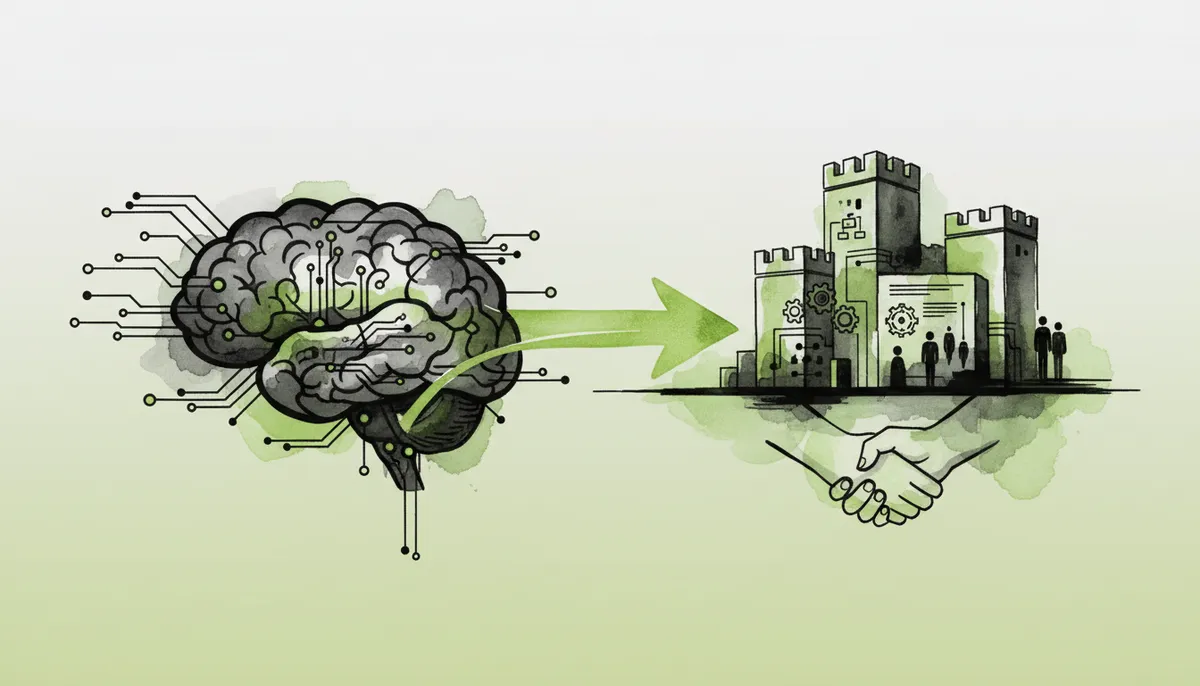
TL;DR: An AI consultancy is a strategic partner that helps businesses leverage artificial intelligence to solve core problems, automate processes, and create a durable competitive edge. This guide covers what an AI consultancy does, the benefits of hiring one in 2026, and how to choose the right partner to design and build custom AI platforms for your startup or SMB.
- Introduction: Navigating the AI Revolution for Your Business
- What is an AI Consultancy? Demystifying the Role
- The Tangible Benefits of Partnering with an AI Consultancy
- How to Choose the Right AI Consultancy: A Practical Checklist
- Comparing Your Options: AI Consultancy vs. In-House vs. Freelancers
- How Techno Believe Can Help
- FAQ
- What’s the difference between an AI consultancy and a managed service provider (MSP)?
- Can an AI consultancy help with both strategy and implementation?
- How does an AI consultancy ensure data privacy and security?
- What are the first steps in engaging with an AI consultancy?
- Is my business too small to benefit from an AI consultancy?
- How do we handle intellectual property (IP) for custom AI models?
- Sources
- Related in this topic
- Related in this topic
- Related in this topic
- Related in this topic
- Related in this topic
Key Takeaways
- An AI consultancy is a strategic partner that helps businesses plan, build, and implement custom AI solutions, from high-level strategy to full-stack deployment.
- The primary benefits of hiring an AI consultancy include faster time-to-market, access to a team of specialized, high-demand experts, and significantly lower risk compared to building an in-house AI team from scratch.
- When choosing a partner, it’s crucial to evaluate their portfolio and relevant case studies, their project management process and communication style, and their deep technical expertise in modern AI stacks.
- For most startups and SMBs, a consultancy offers the best balance of cost, speed, strategic value, and scalability, especially when compared to the high fixed costs of an in-house team or the narrow focus of freelancers.
- A successful AI project is not just about technology; it starts with a clear business strategy and well-defined goals to ensure a positive and measurable return on investment.
- The right consultancy does more than build tools—they build a lasting competitive advantage for your business by embedding intelligence into your core operations, products, and marketing.
Introduction: Navigating the AI Revolution for Your Business
The age of artificial intelligence is no longer on the horizon; it’s the new reality of business in 2026. From generative AI creating hyper-personalized marketing campaigns to sophisticated autonomous AI agents managing complex supply chains, AI is reshaping industries at an unprecedented pace. For business leaders, this presents both a massive opportunity and a significant challenge.
Why AI is No Longer Just for Tech Giants
For years, implementing AI felt like a privilege reserved for companies with billion-dollar R&D budgets. Today, the landscape has changed dramatically. The rise of powerful foundation models and scalable cloud infrastructure has democratized this potent technology. However, this accessibility has created a new problem for many small and medium-sized businesses (SMBs) and startups: a feeling of being overwhelmed. You know you should be using AI, but where do you even begin? What use cases will actually drive ROI? How do you move from a ChatGPT experiment to a production-grade system?
This is where an AI consultancy enters the picture. Think of them as a strategic partner—a team of expert guides who bridge the gap between AI’s vast potential and your specific business reality. They translate complex technology into tangible business outcomes, helping you navigate the hype and focus on what truly matters. This guide will walk you through exactly what an AI consultancy does, how partnering with one can transform your business, and the critical factors to consider when choosing the right one for your journey.
The Cost of Inaction in an AI-Driven Market
In today’s competitive environment, ignoring AI is a strategic risk. Standing still means falling behind competitors who are using AI to enhance their products, personalize customer experiences, and operate with unparalleled efficiency. They are deploying predictive analytics to reduce customer churn, using computer vision to automate quality control, and leveraging generative AI to scale content production. The conversation has shifted from if a business should adopt AI to how quickly and effectively it can be integrated.
Viewing AI not as an expense but as a critical investment is the first step toward future-proofing your business. The cost of inaction—lost market share, operational inefficiencies, and missed growth opportunities—far outweighs the cost of a strategic AI initiative. An AI consultancy helps de-risk this investment and ensures it is targeted at the areas of your business that will produce the greatest return.
What is an AI Consultancy? Demystifying the Role
An AI consultancy provides the strategic guidance, technical expertise, and implementation services necessary for a business to successfully leverage artificial intelligence. They are a multi-disciplinary team of strategists, data scientists, machine learning engineers, and product designers who work together to solve business problems with technology.
Beyond Code: The Core Functions of an AI Consultancy
Hiring an AI consultancy is fundamentally different from just hiring a developer or a data scientist. Their role is holistic, focusing on business value first and technology second. Their work is built on several key pillars:
- Strategy & Roadmapping: They start by understanding your business goals, challenges, and market landscape. Through collaborative workshops, they identify the highest-impact opportunities for AI—from internal process automation to new customer-facing features. The output is a practical, phased roadmap that outlines project priorities, timelines, and expected ROI.
- Data Analysis & Preparation: AI is fueled by data. A consultancy ensures your data is clean, organized, secure, and ready for use. They audit your existing data assets and help you build the necessary data infrastructure (like data warehouses and vector databases) to support robust, scalable AI applications.
- Custom AI Model Development: When off-the-shelf solutions aren’t enough, they design, train, and fine-tune bespoke machine learning models tailored to your unique business challenges. This can range from predictive analytics for sales forecasting, to recommendation engines for e-commerce, or advanced natural language understanding for customer support automation.
- AI Platform Integration: Their ultimate goal is to deliver a functional product. This includes designing and building end-to-end AI platforms—like websites, web apps, mobile apps, and SaaS products—with AI seamlessly integrated at their core to create intelligent, responsive user experiences.
AI Consultancy: A specialized firm that provides end-to-end services to help organizations integrate and leverage artificial intelligence. This includes everything from initial strategy and data readiness assessment to custom model development, platform design, deployment, and ongoing optimization.
The Key Services Offered
While services can vary, a high-quality AI consultancy offers a comprehensive suite of solutions designed to guide you from idea to impact. These core services typically include:
- AI Strategy & Discovery: This foundational phase involves workshops and analysis to assess your business needs, evaluate data readiness, and identify high-ROI AI use cases. The output is a clear, actionable strategy and project roadmap, ensuring that technical development is perfectly aligned with business objectives from day one.
- End-to-End AI Platform Design: This is where ideas become reality. It involves building custom websites, sophisticated web applications, user-friendly mobile apps, and scalable SaaS products that have AI capabilities built in from the ground up. This service covers everything from UI/UX design to backend architecture and full-stack development.
- Custom AI Model Development: For unique business problems, consultancies build bespoke AI models. This could be a recommendation engine to increase sales on an e-commerce site, a predictive model to forecast customer churn, a fraud detection system for a fintech app, or a natural language processing (NLP) tool to analyze customer feedback at scale.
- AI-Powered Marketing & Sales: This service focuses on applying AI to marketing and sales functions. It includes implementing tools for advanced customer segmentation, hyper-personalization of marketing campaigns, AI-driven lead scoring, and optimizing ad spend for maximum return. The impact of how AI is transforming digital marketing cannot be overstated, and a consultancy helps you harness this power.
- AI for Business Automation: This involves identifying and automating repetitive, time-consuming tasks within your operations. By leveraging some of the best AI business automation tools for 2026, a consultancy can implement solutions like intelligent document processing or automated customer service bots, freeing up your team to focus on high-value strategic work.
- Data Infrastructure & Management: Before any AI can be built, the data foundation must be solid. This service involves setting up data warehouses, creating data pipelines, and implementing governance policies to ensure your data is clean, accessible, and secure. This is a critical, non-negotiable step for any serious AI initiative.
The Tangible Benefits of Partnering with an AI Consultancy
Embarking on an AI journey alone can be fraught with risk, high costs, and a steep learning curve. Partnering with an experienced AI consultancy offers a more direct path to success, providing clear, measurable business advantages.
Accelerate Your Time-to-Market
One of the most significant advantages is speed. Building an in-house AI team is a slow and expensive process involving recruitment, hiring, onboarding, and training—all before a single line of code is written. An established AI consultancy arrives with a pre-built team of experts and proven processes, allowing them to start delivering value almost immediately. They’ve already navigated the common pitfalls and can avoid rookie mistakes that often derail internal projects, dramatically shortening the project lifecycle from months or years to a matter of weeks for an initial prototype.
Mitigate Risks and Maximize ROI
AI projects are notoriously difficult to get right. The primary reasons for this high failure rate are a lack of clear strategy, poor data quality, and a disconnect between the technical team and business objectives.
An AI consultancy mitigates these risks through a structured, ROI-focused process. Their methodology typically includes:
- A thorough discovery phase to ensure the project is solving a real, high-value business problem.
- Developing a Proof of Concept (PoC) to validate the technical feasibility and business potential before committing to a large investment.
- A phased rollout that allows for iteration and ensures the final product is perfectly aligned with user needs and business goals.
This disciplined approach ensures that your investment is directly tied to measurable outcomes, maximizing your return on investment and helping you build a SaaS marketing strategy that leverages your new AI capabilities.
Access to Elite, Specialized Talent
The demand for top AI talent—including data scientists, machine learning engineers, and AI strategists—far outstrips the supply, making them incredibly difficult and expensive to hire. For most SMBs, building a well-rounded in-house team is simply not feasible.
A consultancy provides a “team-as-a-service” model. You gain immediate access to a diverse pool of elite, specialized experts for a fraction of the cost of hiring a single full-time senior employee. Furthermore, these experts bring a wealth of cross-industry experience. They have solved similar problems for other clients in different sectors, allowing them to bring fresh perspectives and innovative solutions to your unique challenges.
Gain a Lasting Competitive Advantage
The right AI consultancy doesn’t just deliver a one-off project; they help you build a sustainable competitive moat. By embedding AI into your core products and operations, you create unique capabilities that are difficult for competitors to replicate. An intelligent product that learns from user behavior becomes better and more valuable over time, creating a virtuous cycle that increases customer loyalty and market share. This strategic integration of AI, guided by an expert partner, transitions your business from simply using technology to becoming a technology-driven leader in your industry.
How to Choose the Right AI Consultancy: A Practical Checklist
Selecting the right partner is the most critical decision you’ll make in your AI journey. Not all consultancies are created equal. Use this practical checklist to vet potential partners and find the one that best fits your business needs and culture.
Evaluating Their Portfolio and Industry Experience
Theoretical knowledge is not enough. The best indicator of future success is a track record of past results. Ask to see detailed case studies and examples of projects they have completed. Pay close attention to whether they have experience solving problems similar to yours or working within your industry. A proven portfolio demonstrates that they can not only talk about AI strategy but also execute and deliver tangible business value. A good partner will be eager to show you how they’ve generated ROI for other clients, from developing new products to learning how to use AI for content creation to boost marketing efforts.
See Our Work: Evaluating past projects is key to choosing the right partner. We build end-to-end AI platforms that deliver measurable results — explore our services to see what’s possible.
Assessing Their Process and Communication
A great AI consultancy operates with a transparent, collaborative, and structured process. They should be able to clearly articulate how they will take your project from an idea to a fully deployed solution. Before signing a contract, ask these key questions to assess their approach:
- “How do you define and measure success for an AI project?” (Their answer should focus on business metrics like revenue, cost savings, or efficiency, not just technical metrics like model accuracy.)
- “Can you walk me through your typical project lifecycle, from discovery to deployment and beyond?” (Look for clear phases, milestones, and deliverables.)
- “What is your approach to data governance and ethical AI?” (They should have a robust framework for protecting your sensitive data and mitigating bias.)
- “What level of involvement and what resources will you need from my team?” (This sets clear expectations for collaboration and ensures you are prepared.)
- “How will we communicate? What is the frequency of check-ins and reporting?” (Look for a commitment to regular, transparent communication using modern project management tools.)
Understanding Their Tech Stack and Scalability
The technology choices made early on will have long-term implications. A good partner should be able to explain why they are recommending a particular set of tools or platforms (like AWS SageMaker, Google Vertex AI, or open-source frameworks) and how those choices align with your existing infrastructure and future goals.
Critically, you need a partner who can think beyond the prototype. It’s one thing to build a small-scale model, but it’s another to build a robust, scalable system that can handle real-world data and user traffic. Inquire about their experience with MLOps (Machine Learning Operations), the practice of deploying and maintaining machine learning models in production reliably and efficiently. A tech-agnostic consultancy, one that recommends the best tool for the job rather than pushing a proprietary solution, is often a sign of a more mature and client-focused partner.
Comparing Your Options: AI Consultancy vs. In-House vs. Freelancers
When deciding how to resource your AI initiative, you generally have three options: partnering with a consultancy, building an in-house team, or hiring freelancers. Each has its pros and cons, and the best choice depends on your business’s stage, budget, and project complexity.
Decision Matrix: Finding the Best Fit for Your Business Stage
Use this table to compare the three approaches across the factors that matter most to startups and SMBs.
| Factor | AI Consultancy | In-House Team | Freelancer(s) |
|---|---|---|---|
| Cost | High initial project cost but predictable. Lower long-term overhead than full-time staff. | Very high fixed cost (salaries, benefits, tools). Significant ongoing expense. | Lower hourly/project rate, but costs can scale unpredictably with scope changes. |
| Speed to Impact | Fastest. Leverages a pre-existing team, proven processes, and established infrastructure. | Slowest. Requires a lengthy process of hiring, onboarding, and internal process development. | Variable. Depends heavily on freelancer availability, skills, and project scope. |
| Breadth of Expertise | High. Immediate access to a diverse team of strategists, data scientists, ML engineers, and project managers. | Limited to the specific skills of the individuals you are able to hire. Gaps are common. | Narrow. Typically specialized in one specific area (e.g., NLP or computer vision). |
| Strategic Guidance | Core Offering. Focus is on aligning technology with business goals and maximizing ROI. | Can be influenced by internal politics or a limited, company-centric perspective. | Minimal to none. Primarily focused on task execution, not high-level business strategy. |
| Scalability | High. Easily scales the team up or down based on the project phase, optimizing cost and resources. | Low. Scaling is a slow and expensive process that requires more hiring. | Low to Medium. Coordinating multiple freelancers for complex, scalable projects is difficult. |
| Risk | Low. Proven methodologies, clear contracts, and accountability for delivering results. | High. Risk of bad hires, project failure, and critical knowledge loss if key employees leave. | Medium. Risk of unreliability, missed deadlines, or a lack of ongoing support and maintenance. |
For most startups and SMBs looking to undertake a significant AI initiative, an AI consultancy offers the optimal blend of speed, expertise, and strategic guidance. While an in-house team is the long-term goal for a mature, AI-native company, a consultancy acts as the perfect accelerator to get there. For smaller, well-defined tasks, a specialized freelancer can be effective, but they lack the strategic oversight and end-to-end capabilities needed for building core products.
How Techno Believe Can Help
If you’re an SMB or startup leader, you understand the immense potential of AI but may feel overwhelmed by the complexity of implementation. You need more than just a developer; you need a strategic partner who can connect technology to tangible business outcomes, de-risk your investment, and guide you from a vague idea to a market-ready product. At Techno Believe, we specialize in bridging that gap, acting as the end-to-end AI product development team for businesses ready to build a competitive edge.
Our core offerings are designed to provide a complete solution. We begin with AI Strategy & Discovery, where we work with you to define a clear, ROI-driven roadmap. From there, our End-to-End AI Platform Design service takes over, handling everything from UI/UX to full-stack development. For unique challenges, our Custom AI Model Development team builds bespoke solutions that integrate seamlessly into your platform, creating intelligent, data-driven experiences for your users.
We don’t just build features; we build businesses. By partnering with us, you gain the strategic vision of a high-end consultancy and the hands-on execution of a dedicated development team, all focused on a single goal: your success. Book a free, no-obligation strategy call to discuss how we can build the future of your business together.
FAQ
What’s the difference between an AI consultancy and a managed service provider (MSP)?
An AI consultancy focuses on strategy, custom development, and solving specific business problems with bespoke AI solutions. An MSP typically manages and maintains existing IT infrastructure and software, often offering standardized, off-the-shelf AI tools rather than custom-built platforms.
Can an AI consultancy help with both strategy and implementation?
Yes, the best consultancies are end-to-end partners. They begin with a strategic discovery phase to identify high-ROI opportunities and then proceed to design, build, and deploy the full technical solution, ensuring the technology is perfectly aligned with business goals.
How does an AI consultancy ensure data privacy and security?
A reputable consultancy has robust data governance and security protocols. This includes signing NDAs, using secure data handling procedures, complying with regulations like GDPR and CCPA, and implementing best practices for data encryption, access control, and threat monitoring throughout the project lifecycle.
What are the first steps in engaging with an AI consultancy?
The process usually starts with an initial discovery call to discuss your business challenges and goals. Following that, the consultancy may propose a paid discovery workshop or a small-scale assessment to dive deeper and produce a high-level strategic roadmap and project proposal.
Is my business too small to benefit from an AI consultancy?
Not at all. Many AI consultancies specialize in working with SMBs and startups. They focus on identifying targeted, high-impact projects that can deliver significant ROI without requiring a massive enterprise-level budget, such as automating a key workflow or enhancing a core product feature.
How do we handle intellectual property (IP) for custom AI models?
This should be clearly defined in your contract. Typically, the client owns the IP for any bespoke code and custom-trained models developed specifically for their project. The consultancy retains the rights to their pre-existing tools, frameworks, and general expertise.
Sources
- Gartner Top Strategic Technology Trends for 2026 — An overview of how AI and other technologies are shaping business strategies.
- The state of AI in 2026: The revolution continues — A comprehensive report from McKinsey on AI adoption and trends. (Note: Link is for a past report, illustrating the type of analysis.)
- Artificial intelligence (AI) market size worldwide 2021-2030 — Market analysis and growth projections from Statista.
- Forrester: The Future Of Artificial Intelligence — Industry analysis and predictions on the business impact of AI.
- Stanford Institute for Human-Centered AI (HAI) — Leading academic research and reports on the state of AI, its capabilities, and ethical considerations.
- Why AI Projects Fail — An article from Harvard Business Review detailing common pitfalls in AI implementation.
Related in this topic
- 11 Best AI Tools for Affiliate Marketing in 2026 (Ranked & Reviewed)
- Machine AI Marketing in 2026: The Ultimate Guide & Platform Comparison for B2B SaaS
- 7 Ways to Master AI Customization for SaaS Growth in 2026
- Best AI Copywriting Tools of 2026
- Top Gen AI Software Consulting Services in 2026: Founder’s Guide & Comparison
- 11 Best AI-Driven Marketing Tools for B2B SaaS in 2026
Related in this topic
- 11 Best AI Tools for Affiliate Marketing in 2026 (Ranked & Reviewed)
- Machine AI Marketing in 2026: The Ultimate Guide & Platform Comparison for B2B SaaS
- 7 Ways to Master AI Customization for SaaS Growth in 2026
- Best AI Copywriting Tools for 2026
- Top Gen AI Software Consulting Services in 2026: Founder’s Guide & Comparison
- 11 Best AI-Driven Marketing Tools for B2B SaaS in 2026
Related in this topic
- 11 Best AI Tools for Affiliate Marketing in 2026 (Ranked & Reviewed)
- Machine AI Marketing in 2026: The Ultimate Guide & Platform Comparison for B2B SaaS
- 7 Ways to Master AI Customization for SaaS Growth in 2026
- Best AI Copywriting Tools for 2026
- Top Gen AI Software Consulting Services in 2026: Founder’s Guide & Comparison
- 11 Best AI-Driven Marketing Tools for B2B SaaS in 2026
Related in this topic
- 11 Best AI Tools for Affiliate Marketing in 2026 (Ranked & Reviewed)
- Machine AI Marketing in 2026: The Ultimate Guide & Platform Comparison for B2B SaaS
- 7 Ways to Master AI Customization for SaaS Growth in 2026
- Best AI Copywriting Tools for 2026
- Top Gen AI Software Consulting Services in 2026: Founder’s Guide & Comparison
- 11 Best AI-Driven Marketing Tools for B2B SaaS in 2026
Related in this topic
- 11 Best AI Tools for Affiliate Marketing in 2026 (Ranked & Reviewed)
- Machine AI Marketing in 2026: The Ultimate Guide & Platform Comparison for B2B SaaS
- 7 Ways to Master AI Customization for SaaS Growth in 2026
- Best AI Copywriting Tools for 2026
- Top Gen AI Software Consulting Services in 2026: Founder’s Guide & Comparison
- 11 Best AI-Driven Marketing Tools for B2B SaaS in 2026