
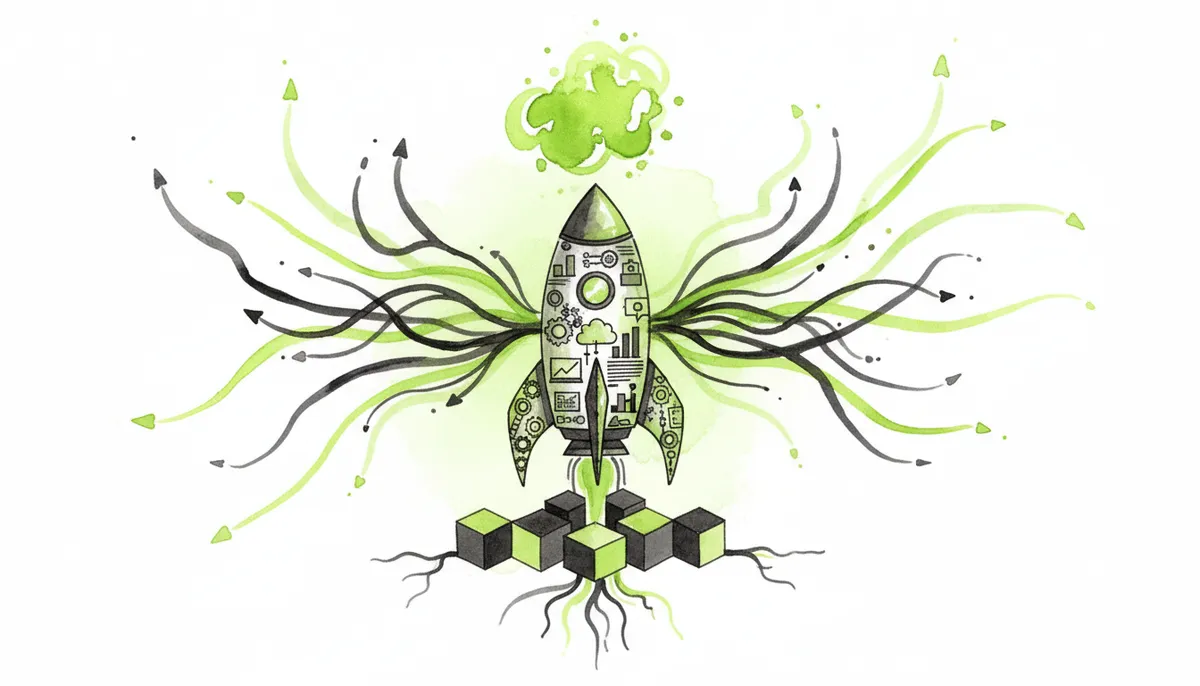
TL;DR: This guide provides the ultimate B2B SaaS marketing strategy for 2026, focusing on an AI-powered, full-funnel approach. We cover everything from demand generation and product-led growth to retention and advocacy, giving founders a complete playbook for scalable, explosive growth.
- Introduction: Navigating the 2026 SaaS Landscape
- Building the Foundation of Your 2026 SaaS Marketing Strategy
- Stage 1: AI-Powered Demand Generation & Awareness
- Stage 2: Converting Traffic into Active Users (Acquisition & Activation)
- Stage 3: Driving Monetization and Expansion Revenue
- Stage 4: Mastering Retention and Advocacy
- The Essential SaaS Marketing Tech Stack for 2026
- Grow Faster with an AI-Powered SaaS Marketing Strategy
- How Techno Believe Can Help
- FAQ
- How much should a SaaS startup spend on marketing?
- What are the most important metrics for a SaaS marketing strategy?
- What is the difference between B2B and B2C SaaS marketing?
- What is Product-Led Growth (PLG) and why is it important?
- How can AI improve my SaaS marketing strategy in 2026?
- Should I focus on SEO or paid ads for my SaaS?
- Sources
Key Takeaways for Your 2026 SaaS Marketing Strategy
- AI is the Operating System: In 2026, a winning SaaS marketing strategy uses AI not as a tool, but as a foundational layer for hyper-personalization, predictive analytics, and operational efficiency across the entire funnel.
- Retention is the Primary Growth Lever: With rising customer acquisition costs (CAC), focusing on reducing churn through exceptional onboarding, customer success, and community building delivers the highest ROI.
- Product-Led Growth (PLG) is Mainstream: The most scalable SaaS companies leverage their product as the primary driver of acquisition, conversion, and expansion. The user experience is the marketing.
- Full-Funnel Content Reigns Supreme: Your content strategy must address every stage of the customer journey. Our 2026 B2B content marketing strategy guide details how to build awareness with top-funnel posts and drive conversions with bottom-funnel case studies.
- Metrics Dictate Momentum: Success is measured. Continuously track MRR, LTV, CAC, and Churn. Aim for the ‘Rule of 40’ (Growth Rate % + Profit Margin % > 40%) to ensure sustainable, healthy growth.
- Authority Builds Trust: Dominate your niche by becoming the go-to educational resource. Invest in thought leadership, data-driven reports, and digital PR to build a brand that buyers trust implicitly.
Introduction: Navigating the 2026 SaaS Landscape
The B2B SaaS market in 2026 is more crowded, competitive, and sophisticated than ever before. A great product is merely the price of entry; a formidable, AI-driven marketing engine is the true differentiator. For B2B founders, navigating this landscape requires a comprehensive SaaS marketing strategy that integrates cutting-edge technology with timeless growth principles.
This guide moves beyond generic advice to provide a strategic framework designed for action. We will detail how to build a scalable growth machine by weaving together advanced AI capabilities with a deep understanding of the customer lifecycle. We’ll explore every stage, from generating initial demand and acquiring users to fostering the loyalty that turns customers into your most powerful marketing channel. Understanding AI’s impact on marketing in 2026 is no longer optional—it’s the core of modern growth.
Building the Foundation of Your 2026 SaaS Marketing Strategy
Before diving into specific tactics, it’s crucial to understand the foundational principles that govern successful SaaS growth in 2026. These concepts provide the “why” behind the “what,” ensuring your efforts are aligned with sustainable, long-term success.
What is a SaaS Marketing Strategy?
A SaaS marketing strategy is a comprehensive, long-term plan designed to attract, convert, and retain customers for a subscription-based software product. Unlike traditional marketing focused on one-time sales, it emphasizes the entire customer lifecycle and is measured by recurring revenue metrics like Monthly Recurring Revenue (MRR), Customer Lifetime Value (LTV), and churn rate.
The goal is not just to win a customer, but to keep them, grow their value over time, and turn them into advocates for your brand. This requires a holistic approach that aligns marketing, sales, product, and customer success teams.
Essential Financial Benchmarks: The Rule of 40 & T2D3
Healthy growth is measured growth. Two key benchmarks help investors and founders alike gauge the health and potential of a SaaS business:
- The Rule of 40: This is a simple heuristic to quickly assess the health of a SaaS company. The formula is: Revenue Growth Rate % + Profit Margin % > 40%. For example, a company growing at 30% with a 15% profit margin (30 + 15 = 45) is considered healthy. In 2026, AI-driven automation in marketing and operations can significantly lower costs, making this rule more attainable even for early-stage companies focused on aggressive growth.
- The T2D3 Growth Rule: This framework describes a common hyper-growth path for venture-backed startups aiming for a billion-dollar valuation. It stands for “Triple, Triple, Double, Double, Double.” For example, a company might grow from $2M to $6M (Triple), then to $18M (Triple), then $36M (Double), and so on. Achieving this trajectory requires a supremely scalable and efficient marketing engine.
From Funnel to Flywheel: The Customer-Centric Model
For years, marketers visualized their process as a linear funnel (Awareness, Interest, Desire, Action). However, the SaaS model thrives on recurring revenue and referrals, which the traditional funnel fails to capture.
Enter the Flywheel model, popularized by HubSpot. This model places the customer at the center and uses the momentum of happy customers to drive further growth. It consists of three phases:
- Attract: Drawing in prospects with valuable content and conversations, establishing yourself as a trusted advisor.
- Engage: Building lasting relationships by providing insights and solutions that align with their pain points and goals.
- Delight: Providing an outstanding experience that empowers customers to succeed, turning them into promoters who add more energy back into the flywheel through referrals and positive reviews.
In the SaaS context, retention fuels acquisition. A delighted customer not only continues to pay you (increasing LTV) but also helps you acquire new customers at a lower cost, creating a self-reinforcing cycle of growth.
Stage 1: AI-Powered Demand Generation & Awareness
The first step in any growth plan is to get on your ideal customer’s radar. In 2026, this means leveraging AI to create and distribute content with unparalleled precision and scale, establishing your brand as an authority in your niche.
Dominating Search with Programmatic & AI-Augmented SEO
Standard blogging is no longer enough to cut through the noise. A modern approach to SEO optimization involves a two-pronged, AI-powered attack:
- Programmatic SEO (pSEO): This involves creating hundreds or even thousands of targeted landing pages at scale by using a database and templates. Think of pages like “[Your Software] vs. [Competitor],” “[Your Software] for [Specific Industry],” or “[Your Software] Integration with [Other Tool].” This allows you to capture long-tail, high-intent search traffic that would be impossible to target manually.
- AI-Augmented Content: Leverage AI to supercharge your content creation process. Use the best AI SEO tools for 2026 for advanced keyword clustering, generating comprehensive content briefs, and optimizing for semantic relevance. This ensures your content not only ranks but also satisfies user intent and adheres to Google’s E-E-A-T (Experience, Expertise, Authoritativeness, Trustworthiness) guidelines.
Need a Plan?: Building a programmatic and AI-driven SEO engine requires specialized expertise that goes beyond traditional content marketing. — Explore our SEO services.
Hyper-Personalized Outreach at Scale
Cold outreach is still a powerful B2B channel, but generic, templated emails are dead. Modern outreach automation tools use AI to achieve personalization at a scale previously unimaginable.
These platforms can scrape data from LinkedIn profiles, company “About Us” pages, and recent news articles to craft highly relevant opening lines and value propositions. This goes far beyond simple {{first_name}} mail merges. The most advanced systems use a Model Context Protocol (MCP), an open standard that ensures AI models have the correct, up-to-date context about a prospect’s company before generating outreach copy. This approach drastically increases reply rates by demonstrating genuine research and relevance.
Building Authority with Thought Leadership & Digital PR
Trust is the currency of B2B sales. The most effective way to build it is by establishing your founder and your company as the definitive thought leaders in your space. This involves a multi-channel strategy:
- Publish Original Research: Conduct surveys or analyze proprietary data to create unique, data-driven reports that the rest of your industry will cite.
- Secure Media Placements: Actively pursue guest appearances on relevant industry podcasts and secure bylines (guest posts) in major publications your audience reads.
- Leverage Digital PR Tools: Use platforms like Qwoted to connect with journalists seeking expert quotes. Providing a valuable quote can earn you high-authority backlinks and brand mentions, boosting both your SEO and your credibility.
Stage 2: Converting Traffic into Active Users (Acquisition & Activation)
Generating traffic is only half the battle. The next critical stage is converting that attention into active, engaged users who experience the core value of your product. This is where a product-led approach shines.
Optimizing the Free Trial & Freemium Experience
The choice between a time-limited free trial and a feature-limited freemium model is a strategic one. A free trial creates urgency and is often better for complex products that require some setup. A freemium model is excellent for products with network effects or a simple core value, allowing a large user base to form.
Regardless of the model you choose, the single most important goal is to guide new users to their “Aha!” moment—the point where they truly understand the core value your product provides. This should happen within their very first session. Use a combination of in-app guides (from tools like Appcues or Pendo) and behavior-triggered email sequences to onboard users effectively and lead them to this critical point of activation.
Product-Led Growth (PLG) as a Core Acquisition Engine
Product-Led Growth (PLG) is a go-to-market strategy that relies on the product itself to acquire, activate, and retain customers. Think of companies like Slack, Calendly, and Figma, where you can get significant value and even invite your team before ever speaking to a salesperson.
PLG is powerful because it reduces friction in the buying process. It leads to lower Customer Acquisition Costs (CAC) and faster growth cycles because the product’s value proposition is demonstrated, not just described.
Comparison Table: Key SaaS Marketing Channels
Choosing where to invest your marketing budget is a critical decision. This table provides a high-level comparison of the most common channels for B2B SaaS.
| Channel | Typical CAC | Time to ROI | Scalability | Best For |
|---|---|---|---|---|
| Content Marketing/SEO | Low | 6-12 months | High | Building long-term authority and sustainable lead flow |
| Paid Search (Google Ads) | Medium-High | Immediate | Medium | Capturing high-intent buyers ready to make a decision |
| Social Media Ads (LinkedIn) | High | Weeks | High | Targeting specific job titles, industries, and companies |
| Cold Outreach Automation | Low-Medium | Weeks | High | Reaching specific decision-makers in target accounts |
| Partner/Affiliate Marketing | Low (Pay-for-Performance) | 1-3 months | Medium | Leveraging other audiences to drive qualified leads |
Stage 3: Driving Monetization and Expansion Revenue
Acquiring a user is just the beginning. The true financial power of the SaaS model comes from recurring and expansion revenue. This involves smart pricing and proactive strategies to grow the value of each customer account.
Data-Driven Pricing and Packaging Strategies for 2026
Your pricing is one of your most powerful marketing tools. In 2026, the most successful SaaS companies are moving beyond simple feature-gating to more sophisticated, value-aligned models.
- Value-Based Pricing: Instead of pricing based on your costs or competitors, tie your pricing tiers directly to the value and ROI your customers receive. This requires a deep understanding of your customer’s business and pain points. AI tools can analyze usage data across segments to identify which features correlate most strongly with customer success, informing your value metrics.
- Usage-Based Pricing: This model is gaining significant traction. Customers pay based on their consumption (e.g., per API call, per GB of data stored, per contact). This aligns their costs directly with the value they derive and allows your revenue to scale automatically as your customers grow.
- Clear Tier Differentiation: Create distinct pricing tiers (e.g., Basic, Pro, Enterprise) with clear feature differentiation that creates a natural upgrade path. Each tier should solve the problems of a specific customer segment.
The Art of the Automated Upsell & Cross-sell
The most profitable revenue in SaaS is expansion MRR—additional monthly recurring revenue from your existing customer base. This can come from users upgrading to a higher-tier plan (upsell) or purchasing an add-on product (cross-sell).
Use your product usage data to trigger automated expansion campaigns. For example:
- When a user on your Pro plan invites their 11th team member (the plan limit is 10), trigger an in-app notification and an email sequence highlighting the benefits of the unlimited-user Enterprise plan.
- If a customer is consistently using 95% of their file storage limit, automatically prompt them to upgrade to the next tier.
Driving expansion MRR is the key to achieving net negative churn, where the revenue gained from existing customers is greater than the revenue lost from customers who cancel. This is a powerful indicator of a healthy, scalable SaaS business.
Stage 4: Mastering Retention and Advocacy
In a subscription economy, customer retention is paramount. Acquiring a new customer is 5 to 25 times more expensive than retaining an existing one. The final stage of a modern SaaS marketing strategy focuses on delighting customers to reduce churn and turn them into advocates.
Personalized Onboarding & Proactive Customer Success
Retention efforts begin the moment a user signs up. A generic onboarding experience leads to confusion and quick churn. Instead, create personalized onboarding flows based on the user’s role or their stated goals during signup.
The role of a Customer Success Manager (CSM) is crucial here. They are not a support team; they are a proactive revenue function. A CSM’s job is to ensure customers are consistently achieving their desired outcomes with your product. By helping customers succeed, they dramatically increase engagement, satisfaction, and ultimately, Customer Lifetime Value (LTV).
Building a Community to Foster Advocacy
One of the most powerful retention tools is a thriving customer community. This can be hosted on platforms like Slack, Discord, or a dedicated forum tool like Circle. A community provides immense value:
- Reduces Support Load: Customers often help each other solve common problems.
- Gathers Product Feedback: It’s a direct line to your most engaged users for ideas and validation.
- Increases Engagement: A community creates stickiness and makes your product a central part of your users’ workflow and professional network.
- Identifies Advocates: It allows you to easily spot your “super-users” who can be tapped for case studies, testimonials, and referrals.
Using AI for Churn Prediction & Prevention
Don’t wait for a customer to cancel to find out they’re unhappy. In 2026, AI can give you an early warning system. By analyzing behavioral data—such as login frequency, key feature adoption rates, number of support tickets filed, and sentiment in communications—AI models can generate a “health score” for each customer account.
When an account’s health score drops below a certain threshold, it can automatically trigger an alert for the Customer Success team. This allows them to intervene proactively with training, support, or a strategic check-in call before the customer even considers churning. According to McKinsey & Company, **”companies leveraging predictive analytics for churn reduction can decrease customer churn by up to 20%.”
Predictive Analytics: Implementing an effective churn prediction model requires significant data science and engineering resources. — Book an audit to assess your readiness.
The Essential SaaS Marketing Tech Stack for 2026
Executing a modern SaaS marketing plan requires a powerful and integrated tech stack. Here are the core categories and top tools B2B founders should consider.
Analytics & Business Intelligence
- Google Analytics 4: Essential for comprehensive website traffic and conversion tracking.
- Mixpanel / Amplitude: For deep product analytics to understand user behavior, funnels, and retention within your app.
- Baremetrics / ChartMogul: For subscription analytics and financial reporting, providing a single source of truth for MRR, Churn, LTV, and other critical SaaS metrics.
SEO & Content Creation
- Ahrefs / Semrush: All-in-one platforms for keyword research, competitor analysis, rank tracking, and backlink audits.
- Clearscope / SurferSEO: For AI-powered content optimization, ensuring your articles are comprehensive and semantically aligned with top-ranking content.
- Jasper / Copy.ai: For AI-assisted content generation and ideation, helping you overcome writer’s block and scale content production. Explore our guide on the best AI copywriting tools of 2026 for more options.
CRM & Marketing Automation
- HubSpot: A leading all-in-one platform for marketing automation, sales pipeline management, and customer service.
- Customer.io / Intercom: Powerful tools for behavior-driven messaging, enabling you to send targeted emails, push notifications, and in-app messages based on user actions.
- Salesforce: The enterprise-grade standard for CRM, offering unparalleled customization and scalability for companies with complex sales processes.
Grow Faster with an AI-Powered SaaS Marketing Strategy
Navigating the complexities of the 2026 SaaS landscape requires more than just a great product—it demands a sophisticated, data-driven, and AI-powered growth engine. By focusing on the entire customer lifecycle, from AI-driven demand generation to predictive churn prevention, you can build a sustainable and scalable business. If you’re ready to build a winning saas marketing strategy, our AI consultancy guide is the perfect next step. To put these principles into action, consider partnering with experts who can help build your growth machine together.
How Techno Believe Can Help
If you’re a B2B SaaS founder, you know that executing a full-funnel strategy like the one outlined here is a monumental task. Juggling AI-driven SEO, product-led growth initiatives, complex analytics, and churn prevention requires a dedicated, expert team. It’s easy to get bogged down in tactics without a cohesive strategy, leading to wasted resources and missed growth opportunities. Techno Believe specializes in cutting through this complexity to build scalable growth engines for ambitious SaaS companies.
Our core offerings are designed to address the most critical leverage points in your growth journey. We provide end-to-end AI-powered SEO and content marketing programs that establish your authority and build a sustainable pipeline of organic leads. For companies embracing a product-led model, we offer PLG consulting to optimize your user onboarding, activation, and monetization funnels. We connect the dots between marketing, product, and data to create a unified, customer-centric growth flywheel.
By integrating advanced AI and proven growth principles, we help you acquire customers more efficiently, increase their lifetime value, and turn them into advocates. The result is a more predictable, profitable, and defensible business. Stop guessing what works and start implementing a data-driven system for growth. Book an audit to diagnose your current strategy and identify your biggest opportunities.
FAQ
How much should a SaaS startup spend on marketing?
A good benchmark is to aim for a Customer Lifetime Value to Customer Acquisition Cost (LTV:CAC) ratio of 3:1 or higher. Early-stage SaaS companies focused on rapid growth often reinvest 40-50% of their revenue back into sales and marketing. If your LTV:CAC ratio is well above 3:1, you can and should spend more aggressively to acquire new customers.
What are the most important metrics for a SaaS marketing strategy?
The five most critical metrics are Monthly Recurring Revenue (MRR) for top-line growth, Customer Acquisition Cost (CAC) for efficiency, Customer Lifetime Value (LTV) for long-term health, Churn Rate (both customer and revenue) for retention, and the LTV:CAC Ratio to ensure profitable growth.
What is the difference between B2B and B2C SaaS marketing?
B2B SaaS marketing typically involves longer sales cycles, higher price points, and convincing multiple stakeholders. It relies on educational content, SEO, and direct outreach. B2C SaaS usually has shorter cycles, lower prices, and often employs viral loops, social media, and influencer marketing to reach a broad audience.
What is Product-Led Growth (PLG) and why is it important?
Product-Led Growth (PLG) is a go-to-market strategy where the product itself drives customer acquisition, activation, and retention. It’s crucial in 2026 because it creates a scalable, low-friction model where users experience value before paying, leading to faster growth and lower acquisition costs.
How can AI improve my SaaS marketing strategy in 2026?
AI can fundamentally transform your strategy by analyzing data to predict customer churn, personalizing website content and emails at scale, and automating outreach with hyper-relevant messaging. It also helps optimize ad spend for maximum ROI and generates data-driven content ideas, improving efficiency across the entire marketing funnel.
Should I focus on SEO or paid ads for my SaaS?
A balanced strategy uses both. In the early stages, paid advertising (PPC) provides immediate traffic and valuable data on which messaging and keywords convert best. SEO is a long-term investment that builds a sustainable, high-ROI channel over time, creating a valuable, durable asset for your business.
Sources
- The Rule of 40 for SaaS and Subscription Businesses — An explanation from Bessemer Venture Partners on this key financial benchmark.
- What is Product-Led Growth? — A definitive guide from OpenView, the firm that coined the term.
- Unlocking the power of predictive analytics in B2B sales — A McKinsey & Company report on the impact of predictive analytics.
- SaaS Growth Benchmarks for Private Companies — Data-driven benchmarks for B2B SaaS company growth from SaaS Capital.
- What Is the Flywheel Model? — HubSpot’s original explanation of the customer-centric growth model.
- AI Will Alter B2B Buying and Selling — A Gartner report on the increasing role of AI and digital channels in the B2B buyer’s journey.
Have a similar challenge? Explore our services.
Related in this topic
- How to Create a Social Media Marketing Strategy in 2026 (A 9-Step Guide for B2B SaaS)
- A Social Media Marketing Strategy for Small Businesses (B2B SaaS Guide for 2026)
- The Ultimate Social media Marketing Strategy Template for B2B SaaS (2026)
- Social Media as a Marketing Strategy: The Definitive B2B SaaS Guide for 2026
- Marketing Strategy Through Social Media: The Definitive 2026 Guide for SaaS Founders
- Social Media Marketing Strategy Development: The 2026 Guide for B2B SaaS