
- TL;DR
- Key Takeaways
- Introduction
- What is Customised AI for Business? (Architecture & Approaches)
- Comparison: Off-the-Shelf AI vs. Customised AI Solutions
- 5 High-ROI Use Cases for Customised AI in B2B SaaS & SMBs
- Step-by-Step Implementation Framework: From Data Audit to Production
- Mitigating Risks: Common Pitfalls and How to Avoid Them
- Frequently Asked Questions
- What is the difference between off-the-shelf AI and customised AI for business?
- How much does it cost to build customised AI for a business in 2026?
- Can customized AI work securely with proprietary customer data?
- What role does the Model Context Protocol (MCP) play in custom AI development?
- How long does it take to deploy a custom AI solution?
- Is fine-tuning always necessary when building custom AI?
- Sources
- Frequently Asked Questions
- Sources
TL;DR
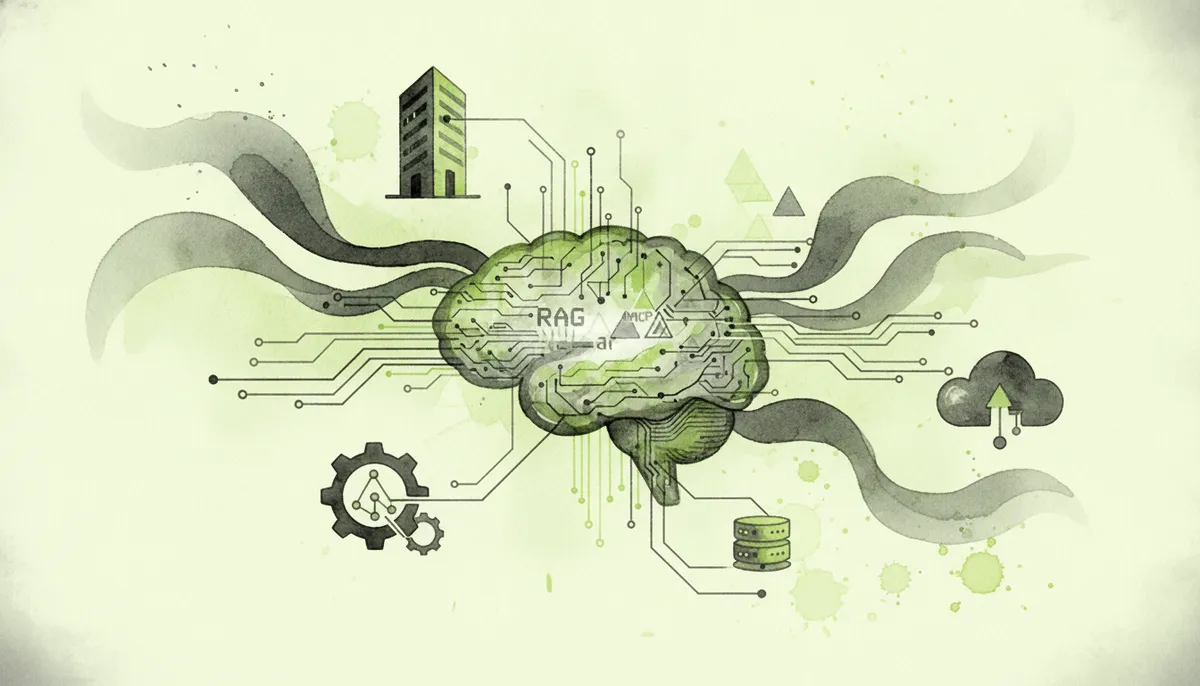
Customised AI for business empowers B2B SaaS founders to move beyond generic LLM wrappers by integrating proprietary data via RAG and MCP architectures. This 2026 strategy guide explores how purpose-built AI agents reduce operational latency, ensure data sovereignty, and create defensible competitive moats for high-growth startups.
Key Takeaways
- Beyond Generative AI: Off-the-shelf models often fail at high-compliance, domain-specific tasks; custom architectures are required for enterprise precision.
- Architecture Shift: The industry is moving toward Small Language Models (SLMs) and Retrieval-Augmented Generation (RAG) to optimize token costs and speed.
- Standardized Integration: Utilizing the Model Context Protocol (MCP) enables secure, unified access to CRM, database, and internal tool data.
- ROI Benchmarks: Implementing custom AI can reduce customer support response latency by up to 40% while automating multi-step lead outreach.
- Defensibility: Proprietary data is your moat; custom AI turns internal operational logs and industry playbooks into unique enterprise value.
Introduction
In 2026, the competitive advantage for B2B SaaS founders no longer lies in merely accessing an LLM, but in implementing customised AI for business that understands the nuances of their specific market. Generic tools provide a baseline, but they lack the proprietary context necessary to solve complex, high-compliance workflows. By shifting from public chatbots to architected AI ecosystems, businesses can finally unlock scalable, secure, and highly accurate automation.
What is Customised AI for Business? (Architecture & Approaches)
Levels of AI Customization: Prompting vs. RAG vs. Fine-Tuning
Customizing AI involves a spectrum of technical complexity, ranging from simple context injection to deep model adaptation. At the foundational level, L1 customization uses prompt engineering to guide model behavior, though it remains highly dependent on public updates. L2, or Enterprise RAG (Retrieval-Augmented Generation), involves indexing your internal knowledge bases using vector search combined with BM25 lexical search to provide grounded, fact-based responses. Finally, L3 involves domain fine-tuning, where open-weights models like LLaMA or Mistral are trained on your specific operational telemetry to master your unique brand voice and technical requirements.
Connecting Silos via Model Context Protocol (MCP)
As defined by Anthropic, the Model Context Protocol (MCP) is an open-standard architecture that allows AI agents to securely connect to external tools, databases, and enterprise software. Instead of building brittle, point-to-point API connectors that break with every update, MCP provides a unified client-server interface. This allows your custom AI agent to query your CRM or Jira boards with granular Role-Based Access Control (RBAC), ensuring that the AI only “sees” the data it is authorized to access.
Data Privacy, Sovereign Infrastructure, and Enterprise Security
Enterprise-grade AI requires a shift toward sovereign infrastructure. Whether deploying via AWS Bedrock, Azure OpenAI Service, or private GPU clusters, the goal is to enforce zero-data retention agreements. By keeping your proprietary data within a Virtual Private Cloud (VPC), you prevent sensitive customer information or internal intellectual property from leaking into the training corpora of public foundation models.
Comparison: Off-the-Shelf AI vs. Customised AI Solutions
Direct Architectural & Commercial Comparison Table
Understanding the trade-offs between generic and tailored solutions is vital for SaaS founders managing limited capital.
| Feature | Off-the-Shelf SaaS | Hybrid RAG Wrappers | Fully Customised AI |
|---|---|---|---|
| Data Security | Limited (Public Cloud) | High (Private VPC) | Maximum (On-Premise) |
| Domain Precision | Low (Generic) | Medium-High | Very High |
| Integration | Limited/Native | MCP-Enabled | Deep/Custom APIs |
| IP Ownership | None | Partial | Full |
Total Cost of Ownership (TCO) & Long-Term Economics
While off-the-shelf subscriptions seem cheap, they often lead to “SaaS bloat” as seat counts grow. Dedicated inference compute and custom development have higher upfront costs but offer lower recurring TCO over a 3-year timeline. By optimizing for token efficiency through RAG rather than massive context windows, companies can significantly reduce their monthly cloud infrastructure spend.
Need a custom roadmap? If you are struggling to calculate the ROI of shifting from generic tools to a proprietary architecture, book an audit and we will map out your specific cost-benefit analysis.
Building a Defensible Moat Around Proprietary Data
Generic wrappers are easily replicated by competitors. A true defensible moat is built by converting your internal operational logs, user behaviors, and industry playbooks into proprietary enterprise value. For those building in this space, AI-Powered Web Development Services: The 2026 Guide for SaaS Founders can provide essential insights on integrating these data layers into your product.
5 High-ROI Use Cases for Customised AI in B2B SaaS & SMBs
Autonomous Multi-Channel Marketing & Cold Outreach
Custom AI agents can execute dynamic email hyper-personalization by analyzing real-time firmographic triggers. Unlike generic tools, these agents are constrained by your verified product specifications, ensuring that every piece of outbound content maintains brand voice consistency. For more on this, explore our B2B SaaS Founder’s Guide to AI Marketing Consultancy in 2026.
Context-Aware Customer Support & In-Product Assistance
Autonomous resolution of complex technical tickets is now possible by querying API docs and user logs in real-time. By deploying domain-specific RAG pipelines, businesses have seen up to a 40% reduction in customer support response latency. When the AI reaches its confidence threshold, it initiates a graceful human-escalation workflow with a pre-generated diagnostic summary.
Intelligent Operations, Workflow Orchestration & Data Synthesis
AI can now automate contract analysis and compliance checking, transforming unstructured documents into structured data. Internal copilots can query Slack archives and Jira boards via unified MCP servers, enabling teams to find information in seconds that previously took hours of manual searching. To see how these automations fit into your broader strategy, read our Custom AI for Growth in 2026: 5 Strategies.
Step-by-Step Implementation Framework: From Data Audit to Production
- Data Readiness: Audit your unstructured data repositories. Clean out noise and duplicates to ensure your vector stores are populated with high-quality, relevant context.
- Model Selection: Choose between frontier models for high-reasoning tasks or open-weight SLMs for edge-case, low-latency execution.
- Orchestration: Design agentic loops using frameworks like LangGraph or native MCP client implementations to manage complex, multi-step tasks.
- Guardrails: Implement LLM evaluation frameworks like RAGAS to monitor for hallucinations. Use Llama Guard to enforce security policies.
- Observability: Track token costs and latency in real-time to prevent runaway infrastructure expenses as your usage scales.
Mitigating Risks: Common Pitfalls and How to Avoid Them
Managing LLM Hallucinations and Semantic Drift
To prevent hallucinations, your system must mandate strict source citation. By implementing confidence thresholds, the AI will refuse to answer if it cannot find supporting evidence in your indexed data. Scheduling automated re-indexing of your knowledge base prevents “semantic drift,” where the AI relies on outdated company information.
Avoiding the ‘Infinite Proof of Concept (PoC)’ Trap
Many teams get stuck in a perpetual PoC phase. Avoid this by defining narrow, measurable KPIs—such as ticket resolution time or lead conversion rates—before writing a single line of code. Start with internal “dogfooding” to refine the system before exposing it to customers.
Regulatory Compliance & Enterprise Governance in 2026
In 2026, aligning your custom AI with the EU AI Act and the NIST AI Risk Management Framework is mandatory for enterprise-level B2B SaaS. Maintain comprehensive audit logs for all synthetic outputs to ensure traceability and bias mitigation.
Ready to scale securely? We help SaaS founders build robust, compliant AI systems that don’t just work, but scale. Explore our services to see how we bridge the gap between AI potential and production-ready reality.
Frequently Asked Questions
What is the difference between off-the-shelf AI and customised AI for business?
Off-the-shelf AI provides generic, pre-trained responses across broad knowledge domains, while customised AI connects proprietary business data, integrates with company workflows via protocols like MCP, adheres to brand guidelines, and meets enterprise security requirements.
How much does it cost to build customised AI for a business in 2026?
Costs range from $10,000–$30,000 for a focused enterprise RAG application to $50,000–$150,000+ for multi-agent autonomous workflow systems, depending on data preparation, infrastructure hosting, and integration complexity.
Can customized AI work securely with proprietary customer data?
Yes. Custom enterprise deployments use dedicated VPCs or private on-premise infrastructure with zero-data retention policies, ensuring data is never used to train public foundation models.
What role does the Model Context Protocol (MCP) play in custom AI development?
MCP is an open standard that allows custom AI models and agents to connect seamlessly and securely to external tools, databases, and enterprise software without writing custom API adapters for every tool.
How long does it take to deploy a custom AI solution?
A scoped Minimum Viable Product (MVP) like an internal knowledge copilot or support agent typically takes 4 to 8 weeks, while full agentic enterprise orchestration requires 3 to 6 months.
Is fine-tuning always necessary when building custom AI?
No. In most business use cases, Advanced Retrieval-Augmented Generation (RAG) combined with structured context injection achieves superior accuracy, lower latency, and simpler maintenance than full fine-tuning.
Sources
- Model Context Protocol Documentation – Anthropic — The official technical standard for connecting AI assistants to data repositories.
- NIST AI Risk Management Framework (AI RMF) — The gold standard for managing AI-related risks and enterprise governance.
- Stanford University HAI AI Index Report — Comprehensive data on the shift toward domain-specific model adoption in enterprise environments.
Have a similar challenge? Explore our services.
Frequently Asked Questions
What is customised ai for business?
customised ai for business is covered in depth earlier in this article. See the introduction and main body for the full explanation, real-world examples, and how to evaluate it for your use case.
How do I get started with customised ai for business?
The article walks through the full implementation path. Start with the step-by-step section and follow the tool recommendations that match your stack and budget.
Sources
- book an audit — Referenced in this article.
- AI-Powered Web Development Services: The 2026 Guide for SaaS Founders — Referenced in this article.
- B2B SaaS Founder’s Guide to AI Marketing Consultancy in 2026 — Referenced in this article.
- Custom AI for Growth in 2026: 5 Strategies — Referenced in this article.
- Explore our services — Referenced in this article.
Related in this topic
- Top AI Consultancy in India (2026): Strategy, Gen AI & Implementation Guide
- Top 15+ AI Agent Icon Resources for SaaS Founders in 2026
- 10 Proven Tips for Adapting to AI and Automation in IT: The 2026 Strategy Guide
- AI-Powered Marketing Automation: The 2026 Playbook for B2B SaaS Growth
- Icon for AI Agents: 7 Design Principles for SaaS in 2026
- AI for Business Automation: 7 High-ROI Systems for SaaS Founders (2026 Guide)