
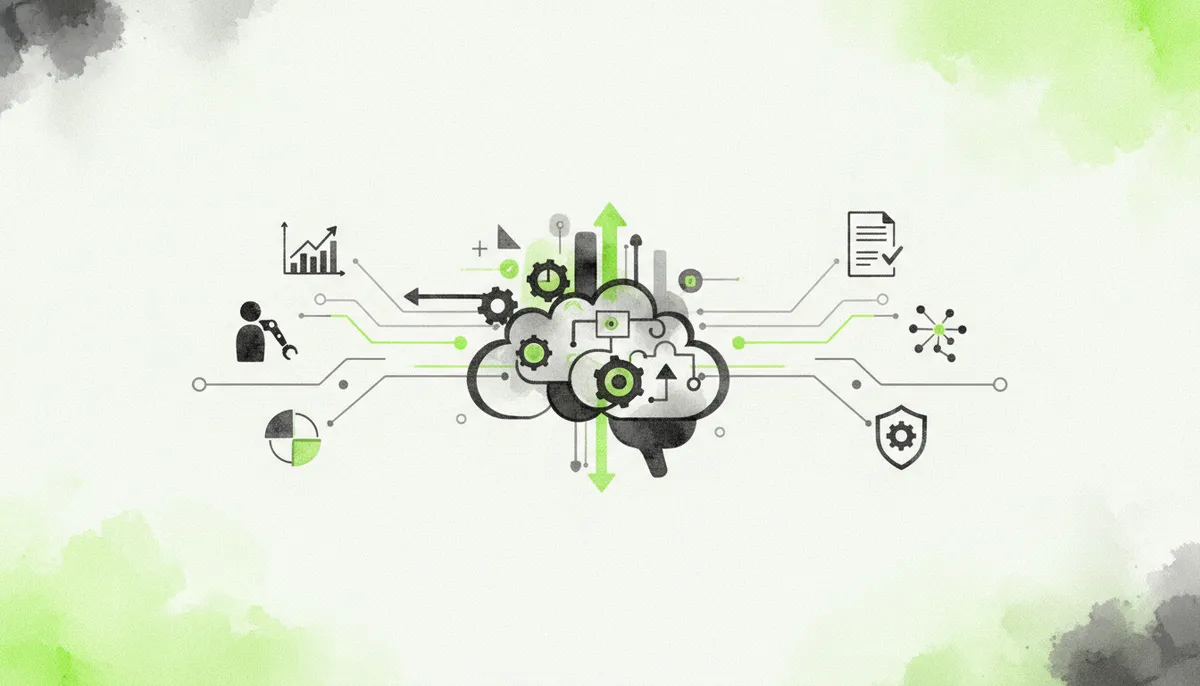
- What is an AI Business Automation Platform (and Why Do Founders Need One in 2026?)
- Key Takeaways: Selecting the Right AI Business Automation Platform
- Prioritizing Integration and Model Context Protocol (MCP) Support
- Balancing Off-the-Shelf SaaS vs. Custom AI Systems
- Focus Areas: Document, Sales, and Machine AI Marketing Automation
- 2. Make.com & Zapier – Best for No-Code Workflow Connections
- 3. HubSpot AI – Best for Sales Automation & CRM-Driven Workflows
- Direct Comparison: Top AI Business Automation Platforms Side-by-Side
- How to Implement AI Business Automation in Your SaaS Workflow
- Frequently Asked Questions
- What is an ai business automation platform?
- How do custom ai systems differ from pre-built SaaS platforms?
- What is the Model Context Protocol (MCP) in modern AI automation?
- Can I use AI for sales automation without losing the personal touch?
- What are the most critical ai automation skills my team should learn?
- How does ai document automation save money for B2B SaaS companies?
- Sources
TL;DR
An AI business automation platform is a foundational tool for 2026, enabling B2B SaaS founders to replace manual, rule-based workflows with autonomous, decision-making AI agents. By leveraging these platforms, companies can scale outreach, automate complex document processing, and integrate multi-modal data streams to drive operational efficiency and revenue growth.
Key Takeaways
- Transition to Agentic AI: 2026 marks the shift from static “if-this-then-that” automation to agentic systems capable of reasoning, planning, and executing multi-step tasks autonomously.
- Model Context Protocol (MCP): Prioritize platforms that support the open MCP standard to ensure seamless data exchange and prevent vendor lock-in.
- Strategic Hybridization: Combine pre-built SaaS platforms for generic workflows with custom-built AI systems for your core proprietary intellectual property.
- High-ROI Focus: Target document parsing, lead scoring, and automated marketing as the three primary pillars for immediate cash-flow improvements.
- Operational Scalability: Scaling successfully requires moving beyond simple API calls toward robust AI systems that handle unstructured data and multi-modal inputs.
What is an AI Business Automation Platform (and Why Do Founders Need One in 2026?)
The Shift from Rule-Based Workflows to Agentic AI
Traditional automation tools once relied on rigid, rule-based triggers. In 2026, the industry has pivoted toward agentic AI—systems that don’t just follow instructions but actively reason through unpredictable variables. Unlike legacy software that breaks when a data format changes, modern AI agents possess the cognitive capacity to plan and execute multi-step workflows, adjusting their approach based on real-time feedback. This evolution allows founders to delegate complex, high-judgment tasks that previously required human oversight.
Key Capabilities: From NLP in AI Automation to Custom AI Systems
Modern platforms leverage advanced Natural Language Processing (NLP) in AI automation to parse unstructured data like legal contracts, customer feedback loops, and complex email threads. While pre-built SaaS integrations offer convenience, they often lack the depth required for proprietary operations. Custom AI systems designed by agencies like Techno Believe enable businesses to process multi-modal inputs—text, voice, and code—to create logic flows that are entirely unique to their product architecture and market positioning.
Core Business Benefits: Saving Time, Scaling Outreach, and Reducing Overhead
The economic mandate for AI adoption is clear. According to IBM’s Global AI Adoption Index, 42% of enterprise-scale organizations have actively deployed AI to drive operational efficiency. By implementing machine AI marketing and sales automation, B2B SaaS founders can eliminate the manual bottlenecks associated with pipeline management. Reallocating engineering resources from mundane maintenance to core product innovation is the primary way startups maintain a competitive edge in 2026.
Key Takeaways: Selecting the Right AI Business Automation Platform
Prioritizing Integration and Model Context Protocol (MCP) Support
The Model Context Protocol (MCP) has become the gold standard for 2026. As an open standard developed by Anthropic, MCP allows for secure, bi-directional data exchange between AI models and your local or remote data sources. Choosing a platform that natively supports this protocol is essential for long-term scalability. It ensures your automation stack remains flexible, allowing you to swap models or data sources without the catastrophic “vendor lock-in” that plagued early SaaS adopters.
Balancing Off-the-Shelf SaaS vs. Custom AI Systems
Not every process requires a bespoke solution. A hybrid approach is often the most cost-effective: use established SaaS platforms for commoditized workflows like calendar scheduling or basic CRM entry, but invest in custom AI systems for your core product differentiators. Security, IP ownership, and deep system integration are the primary drivers for building proprietary automation. If a workflow provides a unique competitive advantage, it should be built custom.
Focus Areas: Document, Sales, and Machine AI Marketing Automation
To maximize ROI, focus on three high-impact domains. First, AI document automation parses invoices and contracts, turning hours of manual entry into seconds of digital processing. Second, AI for sales automation uses predictive lead scoring to ensure your team only engages with high-intent prospects. Third, machine AI marketing ensures your content distribution remains consistent and optimized.
Need a scalable setup? If you are struggling to build a cohesive stack that integrates your sales and marketing data, book an audit — we specialize in scoping custom builds for SaaS founders.
2. Make.com & Zapier – Best for No-Code Workflow Connections
Make.com and Zapier remain the backbone of the no-code movement. Make offers a visual scenario builder that is ideal for complex, multi-step logic, while Zapier provides the largest ecosystem of pre-built integrations. Both have introduced native AI assistants that allow users to build workflows via natural language prompts, though they often hit limitations when tasked with highly complex, agentic reasoning.
3. HubSpot AI – Best for Sales Automation & CRM-Driven Workflows
HubSpot AI is the logical choice for teams already living inside the HubSpot ecosystem. By integrating predictive lead scoring and automated sequencing directly into your CRM, it removes the friction of data synchronization. While it represents a significant cost for early-stage startups, the depth of its sales automation features is difficult to replicate with disparate, disconnected tools.
Direct Comparison: Top AI Business Automation Platforms Side-by-Side
| Platform | Best Use Case | Key Strength |
|---|---|---|
| Make.com | Complex Workflows | Visual logic & granular control |
| HubSpot AI | CRM & Sales Sync | All-in-one data ecosystem |
Total Cost of Ownership: Custom AI Systems vs. Pre-Built Platforms
While SaaS subscriptions are predictable, they scale linearly with usage, often leading to “subscription bloat.” McKinsey research shows that 72% of organizations have adopted AI, with the most successful leaders investing heavily in proprietary models that provide long-term cost savings. A simple ROI calculator for your automation spend should compare: (Total SaaS Subscription Fees over 24 Months) vs. (Initial Development Cost + Annual Maintenance of a Custom System).
Scalability and Developer Flexibility (API & MCP Integrations)
As your API call volume increases, developer-first platforms gain the advantage. Platforms that offer robust SDKs and clear rate-limit management ensure that your infrastructure remains stable as you grow. Furthermore, ensuring data residency compliance (GDPR/CCPA) is significantly easier when you control the architecture of your custom AI systems, rather than relying on a third-party black box.
How to Implement AI Business Automation in Your SaaS Workflow
Step 1: Auditing Your Current Stack for AI Document Automation & Sales Bottlenecks
Start by mapping your data flow. Identify where information manually moves from one app to another—these are your bottlenecks. For example, look for processes like onboarding paperwork or invoice processing that consume your team’s time. These are the prime candidates for AI document automation, which can instantly extract and classify data without human intervention.
Step 2: Training Your Team on Essential AI Automation Skills
The talent gap is real. Your team needs to move beyond simple tool usage to understand prompt engineering, API connectivity, and output validation. Establishing an internal culture of auditing AI results for hallucinations is critical. By fostering these skills, you ensure that your automation doesn’t just run, but runs correctly and compliantly.
Step 3: Partnering with an AI & Technology Consultancy (Like Techno Believe)
Partnering with experts like Techno Believe accelerates your time-to-market. Whether you need a custom web application or an end-to-end AI platform, an agency provides the architecture and continuous optimization that off-the-shelf tools cannot match.
Ready to modernize? If you are looking to replace manual tasks with high-performance AI systems, explore our full suite of services to see how we can help you scale.
Frequently Asked Questions
What is an ai business automation platform?
An AI business automation platform is a software suite or custom system that leverages artificial intelligence, machine learning, and natural language processing to automate complex, decision-based business processes, workflows, and communications without human intervention.
How do custom ai systems differ from pre-built SaaS platforms?
Custom AI systems are tailored specifically to an organization’s proprietary data, unique workflows, and security requirements, offering complete IP ownership and deeper integration. Pre-built SaaS platforms offer faster deployment but less flexibility and ongoing subscription fees.
What is the Model Context Protocol (MCP) in modern AI automation?
Model Context Protocol (MCP) is an open standard developed by Anthropic that enables secure, standardized, bi-directional communication between AI models and data sources, preventing vendor lock-in and simplifying integration.
Can I use AI for sales automation without losing the personal touch?
Yes.
What are the most critical ai automation skills my team should learn?
Key skills include prompt engineering, understanding API integrations, basic data workflow design, and learning how to audit and validate AI-generated outputs for accuracy and compliance.
How does ai document automation save money for B2B SaaS companies?
It uses OCR and NLP to instantly read, classify, and extract data from unstructured documents like contracts, invoices, and receipts, reducing processing times from hours to seconds and eliminating manual entry errors.
Sources
- IBM Global AI Adoption Index — Report on how 42% of enterprise-scale organizations have deployed AI.
- McKinsey State of AI Report — Analysis showing 72% of organizations have adopted AI in at least one function.
- Anthropic Model Context Protocol (MCP) Documentation — Official documentation on the open standard for AI data exchange.
- Salesforce Generative AI IT Leader Survey — Research showing 81% of IT leaders expect generative AI to drive operational efficiency.
Have a similar challenge? Explore our services.
Related in this topic
- Applied AI and Analytics Training and Consultancy: 9 Key Services for 2026
- AI for Business Automation Solution: The 2026 Guide for B2B SaaS & Growing Enterprises
- NLP in AI Automation: The 2026 Guide to Custom AI Systems & Platforms
- AI ML Consulting: 2026 Production Guide
- 11 Best AI Powered Tools for Digital Marketing in 2026 (For B2B SaaS)
- Small Business AI Marketing in 2026: Complete Implementation Guide & Tool Comparison