
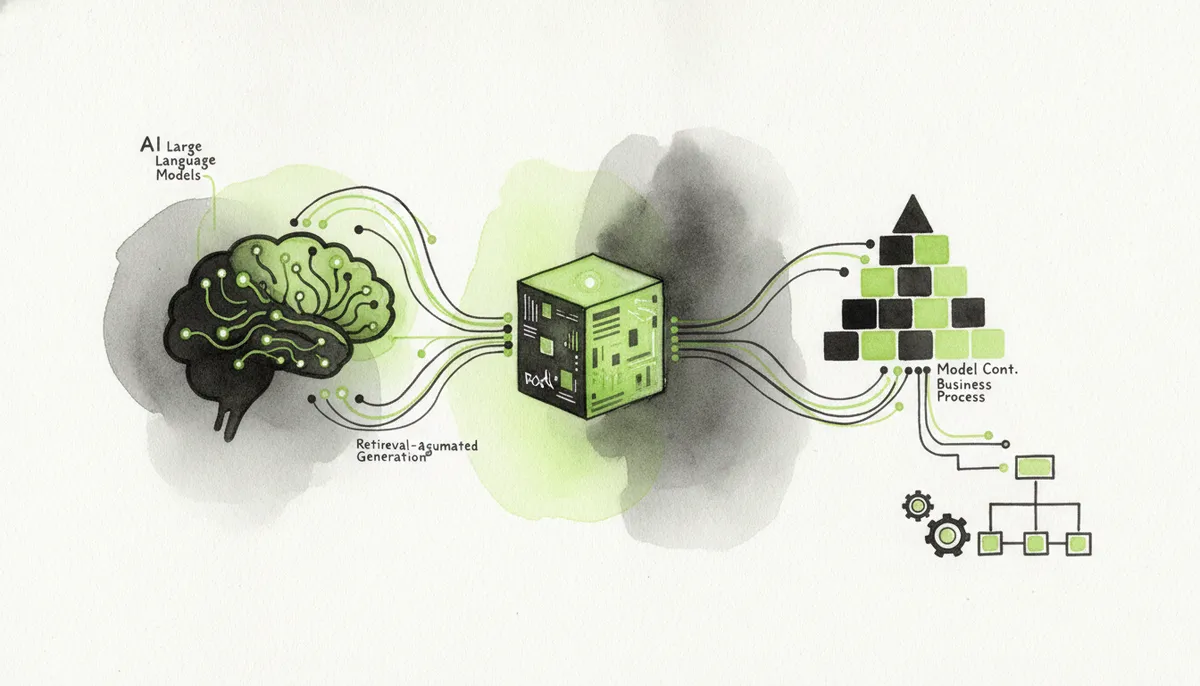
TL;DR: An AI for business automation solution in 2026 combines large language models, retrieval-augmented generation (RAG), and the Model Context Protocol (MCP) to replace brittle, rule-based scripts with autonomous, context-aware operational pipelines. By orchestrating multi-agent systems, modern enterprises eliminate manual unstructured data bottlenecks, cut support resolution times to seconds, and drive scalable, profitable B2B SaaS growth.
- Key Takeaways: Deploying AI Automation in 2026
- What Is an AI for Business Automation Solution in 2026?
- Core Technologies Powering Modern Business Automation
- Comparison: Off-the-Shelf Tools vs. Custom AI Automation Systems
- Step-by-Step Roadmap to Implement an AI for Business Automation Solution
- Real-World Use Cases: B2B SaaS Operations in Practice
- Frequently Asked Questions
- What is the difference between legacy RPA and an AI for business automation solution?
- How does Model Context Protocol (MCP) impact business automation in 2026?
- Is building a custom AI automation system better than using tools like Zapier or Make?
- How does NLP in AI automation improve B2B sales and marketing?
- What are the primary security risks when deploying AI automation solutions?
- How much does it cost to implement an enterprise AI business automation solution?
- Sources
- Related in this topic
Key Takeaways: Deploying AI Automation in 2026
- Context-Driven Autonomy: Modern business automation shifts operations away from brittle “if-this-then-that” rules toward multi-agent frameworks capable of self-directed planning, execution, and verification.
- Standardized Integrations: The Model Context Protocol (MCP) serves as the open integration layer, connecting private LLMs securely to production databases, APIs, and development environments.
- Superior Economics: Custom AI architectures yield lower per-task operating costs and deeper competitive moats compared to generic no-code subscription tools at enterprise scale.
- Unstructured Data Mastery: Natural language processing (NLP) pipelines streamline complex workflows across inbound RFP analysis, dynamic CRM hygiene, and lead scoring.
- Phased Implementation: The fastest path to positive ROI starts with high-frequency, narrow operational bottlenecks before orchestrating full-scale autonomous workflows.
What Is an AI for Business Automation Solution in 2026?
An AI for business automation solution is an integrated software ecosystem that leverages artificial intelligence models, semantic data retrieval, and standardized execution protocols to execute complex, multi-step business workflows autonomously with minimal human oversight.
Unlike legacy automation systems that fail whenever an edge case deviates from a hardcoded rule, an intelligent automation platform reasons through ambiguity. In 2026, software businesses are abandoning sprawling, fragmented SaaS tooling in favor of unified pipelines driven by custom AI for business growth that natively adapt to changing operational contexts.
+-----------------------------------------------------------------------+
|                MODERN AGENTIC AUTOMATION ARCHITECTURE                 |
+-----------------------------------------------------------------------+
|                                                                       |
|  [ Inbound Events ] ---> ( Reasoning Engine / Multi-Agent LLMs )      |
|  - API Webhooks                       |                               |
|  - Raw Inbound RFPs                   v                               |
|  - Support Tickets         [ Contextual Grounding ]                   |
|                            - Vector DBs / RAG                         |
|                            - Model Context Protocol (MCP)             |
|                                       |                               |
|                                       v                               |
|       +-------------------------------+-------------------------------+
|       |                               |                               |
|       v                               v                               v
|  [ Deterministic Actions ]    [ Guardrails & HITL ]    [ Production Systems ]
|  - CRM Updates                - Confidence Checks      - Stripe / Billing    |
|  - Outbound Marketing         - Audit Logging          - Cloud Repositories  |
|                                                                       |
+-----------------------------------------------------------------------+
From Rule-Based RPA to Autonomous Agentic AI
Traditional Robotic Process Automation (RPA) was engineered for deterministic, repetitive mouse clicks and rigid API calls. If an enterprise invoice altered its layout or an incoming customer inquiry included a typo, standard RPA scripts failed.
Modern agentic architectures utilize large language models (LLMs) as high-level reasoning engines. When given an objective—such as triaging a technical support ticket or qualifying an enterprise prospect—the agent dynamically formulates a plan, selects the appropriate tool via API, evaluates intermediate responses, and corrects course when exceptions arise. For B2B SaaS companies, deploying autonomous AI agents eliminates hundreds of manual engineering and operational hours each month.
The Core Architecture: LLMs, RAG, and Model Context Protocol (MCP)
Modern business automation relies on three technical pillars:
Model Context Protocol (MCP): An open standard that enables AI agents to securely discover, read, and write data across disparate corporate databases, internal tools, and external APIs without brittle, custom-coded point-to-point wrappers.
- Reasoning Layer (LLMs): Foundation and fine-tuned models that parse intent, generate code, summarize records, and decide which operational steps to trigger.
- Context Layer (RAG & Vector Stores): Hybrid search engines combining dense vector embeddings with sparse keyword retrieval to ground agent reasoning in proprietary corporate knowledge.
- Connectivity Layer (MCP): Standardized, secure communication pipes that allow LLMs to query production databases, run queries, and update records across platforms.
To ensure compliance with SOC 2, HIPAA, and GDPR standards, production systems implement strict role-based access control (RBAC), end-to-end data encryption, and local execution sandboxes. This prevents proprietary enterprise records from bleeding into public foundational training sets.
High-Impact Operational Domains
The shift toward intelligent automation delivers measurable efficiency across core software operations:
- Customer Success & Onboarding: Context-aware agents resolve developer documentation queries and flag drop-offs in activation milestones.
- Revenue Operations & Sales Intelligence: Inbound prospect enrichment, automated TAM scoring, and contextual account routing occur in real time.
- Engineering & Code Quality: Continuous integration workflows triage test failures, generate pull-request summaries, and flag performance regressions.
- Financial Operations: Automated billing reconciliation, contract parsing, and usage-based dunning drastically reduce revenue churn.
Core Technologies Powering Modern Business Automation
Building a scalable ai for business automation solution requires combining specialized machine learning capabilities into a coordinated execution pipeline.
+-----------------------------------------------------------------------------+
|                      AGENTIC ORCHESTRATION PIPELINE                         |
+-----------------------------------------------------------------------------+
|                                                                             |
|   +---------------------------------------------------------------------+   |
|   | 1. PLANNER AGENT: Deconstructs objective into discrete sub-tasks    |   |
|   +---------------------------------------------------------------------+   |
|                                      |                                      |
|                                      v                                      |
|   +---------------------------------------------------------------------+   |
|   | 2. EXECUTOR AGENT: Calls tools, runs vector queries & MCP APIs      |   |
|   +---------------------------------------------------------------------+   |
|                                      |                                      |
|                                      v                                      |
|   +---------------------------------------------------------------------+   |
|   | 3. VERIFIER AGENT: Inspects outputs against safety & format rules   |   |
|   +---------------------------------------------------------------------+   |
|                                      |                                      |
|                   +------------------+------------------+                   |
|                   | Pass                                | Fail              |
|                   v                                     v                   |
|        [ Commit to Production ]              [ Route to HITL Queue ]        |
|                                                                             |
+-----------------------------------------------------------------------------+
NLP in AI Automation for Unstructured Data Processing
Unstructured data—including emails, chat transcripts, PDF contracts, and audio recordings—represents over 80% of enterprise information. Standard natural language processing (NLP) pipelines parse this data at scale through:
- Zero-Shot Classification & Entity Extraction: Inbound enterprise RFPs are immediately categorized by product line, while metadata such as budget, security prerequisites, and decision-maker names are structured into clean JSON objects.
- Semantic Sentiment Analysis: By tracking lexical nuances and changes in communication tone across support tickets, AI pipelines flag accounts at risk of churning before an escalation occurs.
- Data Hygiene Automation: Disorganized CRM notes, meeting recordings, and email threads are distilled into structured fields, keeping pipelines accurate without requiring manual rep input.
Evaluating your data readiness? If you need an objective assessment of your technical pipelines and AI automation readiness, book an audit with our technical team to identify your highest-ROI opportunities.
Autonomous Multi-Agent Orchestration
Complex business processes fail when handled by a single monolithic prompt. Enterprise architectures utilize multi-agent orchestration, dividing labor among specialized micro-agents:
- Planner Agents: Deconstruct high-level business goals (e.g., “Analyze Q1 user churn”) into a structured sequence of discrete sub-tasks.
- Executor Agents: Execute specific steps using specialized tools, such as running SQL queries, reading API payloads, or searching vector stores.
- Verifier/Critic Agents: Audit the output of executor agents against quality thresholds, schema requirements, and safety policies before committing changes.
To mitigate hallucination risks during financial or legal transactions, engineers embed deterministic Human-in-the-Loop (HITL) checkpoints. If an agent’s confidence score drops below a set threshold, the execution pauses and routes the edge case to a human specialist for verification.
Inbound Payload ---> [ Confidence Metric > 0.95? ]
                           |               |
                         (Yes)            (No)
                           |               |
                           v               v
                   [ Auto-Execute ]   [ Route to HITL Queue ]
Machine AI Marketing & Outbound Lead Intelligence
Revenue acceleration relies on connecting outbound marketing systems directly to dynamic sales intelligence. Modern machine AI marketing platforms analyze domain health, optimize inbox warm-up schedules, and adjust outbound volume dynamically to maximize inbox placement.
By integrating predictive intent signals with conversational LLMs, marketing engines generate deeply contextual outreach. Instead of generic email blasts, outbound agents synthesize prospect LinkedIn updates, recent company news, and hiring trends to craft personalized pitches that yield high reply and meeting conversion rates.
Comparison: Off-the-Shelf Tools vs. Custom AI Automation Systems
Choosing the right platform architecture determines whether an automation initiative becomes a competitive moat or a technical liability.
| Vector | Legacy Automation (Zapier/Make) | Enterprise SaaS AI (Salesforce/Workato) | Custom AI Automation System |
|---|---|---|---|
| Reasoning Depth | None (Static boolean triggers) | Moderate (Vendor-locked features) | Deep (Multi-agent orchestration & planning) |
| Data Sovereignty & Privacy | Low (Data flows through third-party shared servers) | Medium (Cloud-hosted enterprise silo) | Absolute (Dedicated VPC or on-prem deployment) |
| Operating Latency | High (5–15 minute polling intervals) | Moderate (1–5 seconds per workflow) | Ultra-Low (<500ms via optimized async APIs) |
| Cost Scaling Model | Per-task pricing (Scales poorly at high volume) | Seat licenses + add-on consumption credits | Fixed infrastructure + direct LLM token costs |
| API Customizability | Constrained to available public integrations | Constrained to vendor ecosystem | Unlimited (Full access via REST, GraphQL, MCP) |
MONTHLY OPERATING COST VS. TRANSACTION VOLUME
Cost ($)
  ^
  |                                        / (No-Code Per-Task Tools)
  |                                      /
  |                                    /
  |         -------------------------/ (Enterprise SaaS Licenses)
  |       /
  |     /
  |   /--------------------------------- (Custom AI System - Flat Infrastructure)
  |
  +----------------------------------------------------> Volume (Tasks / Mo)
High-Volume Task Economics and Bottlenecks
While no-code automation platforms are suitable for basic internal notifications, fast-scaling B2B SaaS companies encounter steep pricing cliffs when processing hundreds of thousands of operations. Per-task pricing models penalize growth.
Furthermore, generic SaaS tools lack deep reasoning capabilities. When an API payload changes or an edge case occurs, workflows break silently. Building custom pipelines on open frameworks ensures that the system handles schema changes gracefully while keeping operational margins healthy.
When to Hire an AI Systems Partner
Startups often begin with internal prototypes before hitting operational limits related to model hallucinations, integration latency, and infrastructure maintenance. Partnering with a dedicated AI engineering consultancy like Techno Believe allows founders to deploy battle-tested architectures without pulling core software engineers away from the core product roadmap.
Working with a specialist team guarantees proper data isolation, custom RAG tuning, and reliable integration with internal data layers. Understanding the true ROI of tailored AI solutions ensures your capital is invested in resilient, proprietary assets rather than short-lived third-party subscriptions.
Total Cost of Ownership (TCO) Comparison:
+--------------------------------------------------------------------------+
| Off-the-Shelf SaaS Tools:                                               |
| High Per-Seat Fees + Task Overages + Fragmented Logic = Compounding Cost |
+--------------------------------------------------------------------------+
| Custom Engineered Architecture:                                          |
| One-Time Build + Low Token Costs + Full Ownership = High Gross Margins   |
+--------------------------------------------------------------------------+
Enterprise B2B SaaS vs. D2C Automation Needs
The technical demands of B2B SaaS differ fundamentally from Direct-to-Consumer (D2C) businesses. D2C operations prioritize high-volume, low-complexity transactional tasks such as returns processing, simple order status messaging, and catalog tagging.
B2B SaaS architectures demand multi-tenant data isolation, detailed audit logging for compliance, and complex role-based access controls. Because B2B contract values are substantially higher, automation systems must maintain strict output accuracy, making dedicated verifier agents and secure MCP integration essential.
Step-by-Step Roadmap to Implement an AI for Business Automation Solution
Deploying enterprise-grade automation requires a disciplined, iterative software engineering process.
IMPLEMENTATION ROADMAP:
[ Step 1: Bottleneck Scoring ]
       │
       ▼
[ Step 2: Infrastructure & MCP Design ]
       │
       ▼
[ Step 3: Observability & Deployment ]
Step 1: Identifying & Scoring High-ROI Bottlenecks
Avoid the temptation to automate every process at once. Use a standardized scoring matrix to evaluate potential workflows across three primary variables:
$$\text{Automation Priority Score} = \frac{\text{Weekly Frequency} \times \text{Human Error Cost}}{\text{Integration Complexity}}$$
+-----------------------------------------------------------------------------+
|                     BOTTLENECK IDENTIFICATION MATRIX                        |
+-----------------------------------------------------------------------------+
|                                                                             |
|   HIGH IMPACT  │  [ Priority 2: High Value ]    [ Priority 1: BUILD HERE ]  |
|                │  - Complex contract reviews     - Inbound lead qualification|
|                │  - Churn intervention logic     - Tier-1 API ticket triage  |
|                ├───────────────────────────────┼────────────────────────────|
|   LOW IMPACT   │  [ Priority 4: Deprioritize ]  [ Priority 3: Low-Code Fix ]|
|                │  - Ad-hoc slide formatting      - Internal Slack alerts     |
|                │  - One-off metric summaries     - Basic contact syncing     |
|                └───────────────────────────────┴────────────────────────────|
|                                LOW FREQUENCY                  HIGH FREQUENCY|
|                                                                             |
+-----------------------------------------------------------------------------+- Target Repetitive Touchpoints: Focus on high-volume workflows such as API developer onboarding, tier-upgrade verifications, and dunning cycles.
- Establish Baseline Metrics: Document your current Mean-Time-to-Resolution (MTTR), customer acquisition cost (CAC), and labor hours per ticket before deploying models.
- Define Pass/Fail Thresholds: Determine acceptable accuracy boundaries (e.g., zero false positives for financial dunning workflows).
Step 2: Designing the Data Infrastructure & MCP Connectors
With targets identified, engineers must build the connectivity layer that supplies agents with clean context:
- Audit Production APIs: Map all internal REST and GraphQL endpoints that agents will need to read from or write to.
- Deploy Model Context Protocol (MCP) Servers: Standardize authentication, schema definitions, and tool capabilities across external platforms and internal microservices.
- Curate Knowledge Bases: Clean historical ticket resolutions, product documentation, and CRM data to prevent agents from grounding their reasoning in obsolete business logic.
- Build Synthetic Test Suites: Run edge-case evaluation benchmarks against curated datasets to evaluate agent behavior before launching in production.
Building complex product architectures? If you are scaling an enterprise web platform alongside custom AI pipelines, explore our comprehensive web application development services to ensure scalable backend stability.
Step 3: Deployment, Guardrails, and Continuous Observability
Launching an AI automation pipeline marks the beginning of an ongoing optimization loop:
[ Inbound Event ] ──> [ LLM Tracing (OpenInference) ] ──> [ Latency Check ]
                                                                 │
      ┌──────────────────────────────────────────────────────────┴───────┐
      ▼                                                                  ▼
 [ Normal Run ]                                                  [ Circuit Breaker ]
      │                                                                  │
      ▼                                                                  ▼
[ Output Validation ] ──> (Schema Failure?) ──> [ Yes ] ──> [ Deterministic Fallback ]- Implement LLM Tracing: Monitor per-call token consumption, execution latency, and agent decision chains using OpenTelemetry or dedicated LLM tracing frameworks.
- Configure Circuit Breakers: Establish deterministic fallback mechanisms. If an external AI provider experiences elevated latency or outages, the system should gracefully degrade to static routing without dropping incoming data.
- Continuously Tune Prompts and Tools: Refine tool parameter descriptions and system prompts based on telemetry collected from edge-case failures in production.
Real-World Use Cases: B2B SaaS Operations in Practice
Leading software organizations are deploying modern AI architectures to automate complex operational workflows.
+-----------------------------------------------------------------------------+
|                END-TO-END AUTONOMOUS ABM ENRICHMENT PIPELINE                |
+-----------------------------------------------------------------------------+
|                                                                             |
|  [ Visitor Intent ] ──> Reverse IP Lookup ──> Clearbit/Apollo Enrichment    |
|                                                      │                      |
|                                                      ▼                      |
|  [ Custom Outreach ] <── Dynamic Copy Gen <── Scrape Recent News & 10-K     |
|         │                                                                   |
|         ▼                                                                   |
|  [ Inbox Routing ]  ──> Auto-Book Meeting via Calendar MCP Endpoint         |
|                                                                             |
+-----------------------------------------------------------------------------+
Autonomous Account-Based Marketing (ABM) & Enrichment
High-growth SaaS platforms deploy autonomous agents to run full-cycle outbound prospecting. When high-intent accounts browse pricing pages, reverse-IP lookups identify the enterprise domain.
The system triggers an agent to query enrichment databases, scrape public securities filings or recent press releases, and compose personalized emails addressed to specific department heads. By rotating dynamic natural language templates and monitoring domain health, companies maintain high inbox deliverability while driving consistent sales pipeline. For strategic direction, many teams consult a specialized AI marketing consultancy to align agent workflows with revenue targets.
Tier-1 Technical Support & Product-Led Onboarding
Developer-focused SaaS companies face high volumes of nuanced technical support inquiries. Standard chatbots often fail because they lack real-time context regarding user environment variables or active workspace state.
Modern agentic support engines leverage vector search over current documentation alongside live MCP queries to inspect user account logs. When a developer encounters an API error, the agent analyzes the raw stack trace, cross-references internal documentation, and returns a verified code snippet within 30 seconds. If user onboarding milestones stall, the system initiates contextual in-app guidance to accelerate product adoption.
Automated Financial & Subscription Operations
Subscription billing across enterprise accounts frequently involves custom invoicing terms, annual usage true-ups, and varying regional tax laws.
AI-powered financial pipelines intercept billing events from Stripe or Chargebee, automatically reconcile payments against internal database logs, and flag discrepancies. When payments fail, dynamic dunning agents analyze past payment patterns and account health to select the optimal messaging tone and timing, recovering recurring revenue without damaging customer relationships.
Frequently Asked Questions
What is the difference between legacy RPA and an AI for business automation solution?
Legacy RPA strictly executes deterministic, hardcoded rules (“if X, do Y”) and breaks whenever interfaces or data formats change. An AI business automation solution uses LLMs, natural language processing, and autonomous agents to interpret unstructured data, adapt to novel scenarios, and make complex operational decisions dynamically.
How does Model Context Protocol (MCP) impact business automation in 2026?
The Model Context Protocol (MCP) standardizes how AI agents securely read and write data across disparate corporate databases, third-party SaaS applications, and internal microservices. It replaces fragile, custom-coded API wrappers with an open, secure communication protocol for enterprise AI systems.
Is building a custom AI automation system better than using tools like Zapier or Make?
For low-volume, non-critical tasks, no-code platforms are adequate. However, for B2B SaaS companies handling sensitive proprietary data or high task volumes, custom AI architectures provide significantly lower operating costs at scale, absolute data privacy, lower API latency, and deep logic customizability.
How does NLP in AI automation improve B2B sales and marketing?
Natural language processing automates unstructured data extraction from inbound RFPs, enriches customer profiles by analyzing public filings and news, and generates context-aware outreach copy. This eliminates manual CRM data entry and significantly improves outbound response rates.
What are the primary security risks when deploying AI automation solutions?
The primary security risks include prompt injection vulnerabilities, proprietary data leakage into public foundation models, and unvalidated tool execution via APIs. Organizations mitigate these risks through strict role-based access control (RBAC), private VPC model deployments, output validation filters, and human-in-the-loop checkpoints.
How much does it cost to implement an enterprise AI business automation solution?
Costs vary based on system scope and architectural complexity. Basic out-of-the-box SaaS subscriptions carry recurring monthly fees and variable per-task surcharges, whereas custom-engineered multi-agent pipelines deployed by an engineering partner require an upfront build investment but offer dramatically lower ongoing operational and token costs.
Sources
- Model Context Protocol (MCP) Specification — The open standard for connecting AI models to secure local and remote data sources.
- Anthropic: Building Effective Agents — Research and architectural design patterns for multi-agent reasoning, planning, and tool use.
- OpenAI API Documentation: Function Calling & Agents — Technical specifications for deterministic function calling, structured outputs, and agentic workflows.
- W3C Web Data Architecture and Semantic Standards — Global standards for data interoperability, semantic schema formats, and structured web ontologies.
Related in this topic
- NLP in AI Automation: The 2026 Guide to Custom AI Systems & Platforms
- AI ML Consulting in 2026: The Founder’s Guide to Production AI & Autonomous Systems
- 11 Best AI Powered Tools for Digital Marketing in 2026 (For B2B SaaS)
- Small Business AI Marketing in 2026: Complete Implementation Guide & Tool Comparison
- AI Automation Agency Services: The 2026 Guide for B2B SaaS
- 10 Best AI Tools for Social Media Marketing in 2026 (Ranked for B2B SaaS)
Related in this topic
- NLP in AI Automation: The 2026 Guide to Custom AI Systems & Platforms
- AI ML Consulting in 2026: The Founder’s Guide to Production AI & Autonomous Systems
- 11 Best AI Powered Tools for Digital Marketing in 2026 (For B2B SaaS)
- Small Business AI Marketing in 2026: Complete Implementation Guide & Tool Comparison
- AI Automation Agency Services: The 2026 Guide for B2B SaaS
- 10 Best AI Tools for Social Media Marketing in 2026 (Ranked for B2B SaaS)
Related in this topic
- NLP in AI Automation: The 2026 Guide to Custom AI Systems & Platforms
- AI ML Consulting: 2026 Production Guide
- 11 Best AI Powered Tools for Digital Marketing in 2026 (For B2B SaaS)
- Small Business AI Marketing in 2026: Complete Implementation Guide & Tool Comparison
- AI Automation Agency Services in 2026
- 10 Best AI Tools for Social Media Marketing in 2026 (Ranked for B2B SaaS)
Related in this topic
- NLP in AI Automation: The 2026 Guide to Custom AI Systems & Platforms
- AI ML Consulting: 2026 Production Guide
- 11 Best AI Powered Tools for Digital Marketing in 2026 (For B2B SaaS)
- Small Business AI Marketing in 2026: Complete Implementation Guide & Tool Comparison
- AI Automation Agency Services in 2026
- 10 Best AI Tools for Social Media Marketing in 2026 (Ranked for B2B SaaS)