
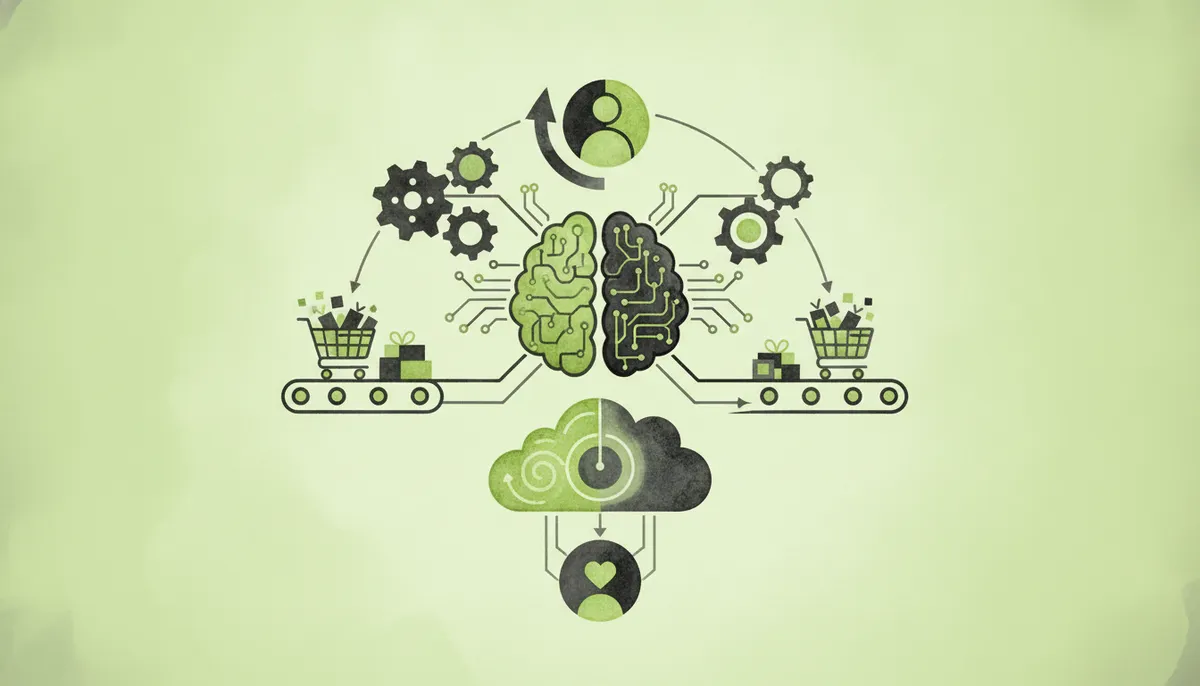
TL;DR: To master the best practices for AI and automation in ecommerce, founders must prioritize hyper-personalization, unified data architectures, and the Model Context Protocol (MCP). By integrating these technologies, businesses can reduce acquisition costs, streamline customer support, and achieve significant revenue growth through data-driven, machine-learning-powered marketing strategies.
- Key Takeaways: AI & Automation in Ecommerce
- Why AI and Automation are Redefining Ecommerce in 2026
- 10 Best Practices for AI and Automation in Ecommerce
- Comparing the Best AI Automation Platforms for Enterprises vs. SMBs
- How Techno Believe Can Help
- Frequently Asked Questions
- What are the best practices for ai and automation in ecommerce for 2026?
- How does NLP in ai automation improve the online shopping experience?
- Why should small businesses invest in small business ai marketing tools?
- What is the Model Context Protocol (MCP) in modern AI systems?
- How do we choose the best ai automation platforms for enterprises?
- Frequently Asked Questions
- What is best practices for ai and automation in ecommerce?
- How do I get started with best practices for ai and automation in ecommerce?
- How does why ai and automation are redefining ecommerce in 2026 actually work?
- How does 10 best practices for ai and automation in ecommerce actually work?
- How does comparing the best ai automation platforms for enterprises vs. smbs actually work?
- Sources
Key Takeaways: AI & Automation in Ecommerce
- Hyper-personalization is no longer optional; it drives up to 15% revenue lift via machine AI marketing.
- Model Context Protocol (MCP) is now the open standard for connecting LLMs to secure ecommerce databases.
- Successful integration requires aligning IT infrastructure with business automation AI tools early in the process.
- B2B SaaS founders should focus on building modular AI features rather than monolithic suites.
- Data privacy and compliance must remain at the forefront of any AI for business automation solution in 2026.
- Modern AI agents can resolve complex customer queries without human intervention when given access to real-time inventory and historical data.
Why AI and Automation are Redefining Ecommerce in 2026
The ecommerce landscape has shifted from static, rule-based systems to dynamic, intent-aware environments. Implementing the best practices for AI and automation in ecommerce is now the primary differentiator for brands seeking to scale efficiently. By moving beyond simple automation, forward-thinking companies are leveraging machine learning to predict customer needs before they are explicitly stated.
The Shift to Hyper-Personalization and Machine AI Marketing
Static segmentation is a relic of the past. In 2026, machine AI marketing dynamically adjusts content, pricing, and product recommendations based on real-time user intent. By utilizing predictive modeling, brands can move away from “one-size-fits-all” campaigns toward hyper-individualized journeys. As noted in industry research, effective personalization can reduce customer acquisition costs by up to 50% and lift total revenues by 5% to 15%.
How NLP in AI Automation is Revolutionizing Customer Support
Natural Language Processing (NLP) has evolved chatbots from simple scripted menus into highly contextual, multi-turn conversational agents. These agents can now resolve complex queries—such as tracking, returns, or technical product compatibility—without human intervention. A critical development in this space is the Model Context Protocol (MCP), an open standard that allows LLMs to securely fetch real-time shipping and inventory data, ensuring customers receive accurate answers instantly.
Overcoming Integration Hurdles: Tips for Adapting to AI and Automation in IT
Legacy system bottlenecks remain the biggest barrier to AI adoption. To succeed, businesses must adopt API-first architectures and headless commerce frameworks that allow AI layers to sit on top of existing data. Furthermore, data sanitization is a mandatory prerequisite; feeding “dirty” or siloed data into LLM pipelines will only result in inaccurate outputs. For a deeper look at these architectural shifts, explore our AI-powered web development services for SaaS.
10 Best Practices for AI and Automation in Ecommerce
Adopting these practices requires a shift in mindset from “adding a feature” to “building an intelligent ecosystem.”
1. Unify Customer Data for Machine AI Marketing
You cannot automate what you cannot see. Break down data silos across your CRM, ERP, and web analytics to create a single source of truth. With clean, unified data, your machine learning models can power real-time predictive analytics and ultra-relevant email campaigns that resonate with user behavior.
2. Deploy NLP-Powered Conversational Agents (Using MCP Standards)
Utilize the Model Context Protocol (MCP) to allow your AI agents to securely read inventory databases and customer history. By providing the AI with the right context, you ensure that responses are not just generic, but highly specific to the user’s current order status or technical needs.
Need help with integration? If you are struggling to connect your legacy backend to modern AI agents, book an audit and let us map out your secure integration path.
3. Leverage AI for Predictive Inventory & Dynamic Pricing
Implement machine learning algorithms that forecast demand based on seasonality, social trends, and historical sales data. Simultaneously, deploy dynamic pricing models that adjust in real-time to competitor movements and market demand, ensuring you maximize margins without eroding your brand value.
Comparing the Best AI Automation Platforms for Enterprises vs. SMBs
Choosing the right technology stack depends on your business maturity and technical resources.
Enterprise-Grade AI Suites vs. Lightweight Small Business AI Marketing Tools
Enterprises often require custom-built AI platforms that offer full control over data residency and orchestration, whereas SMBs benefit from lightweight, SaaS-based integrations that offer rapid deployment. The primary trade-off is between the high development cost of custom LLM middleware and the rigid API limitations of off-the-shelf tools.
Comparison Table: Best AI Automation Platforms
| Platform Category | Target Audience | Core Strengths | Key Limitations |
|---|---|---|---|
| Custom AI Platforms | Enterprises | High customization, MCP support | High development cost/timeline |
| SMB AI Marketing Tools | Small Business | Low cost, fast deployment | Limited scalability, rigid APIs |
| Hybrid B2B SaaS | Mid-Market | Balanced cost, modular APIs | Moderate integration effort |
Selecting the Right AI for Business Automation Solution
B2B SaaS founders should look for a solution that prioritizes open API access and robust security compliance (such as SOC2 and GDPR). Your stack must be modular; if you cannot swap out an LLM provider or update your database connector without a full system overhaul, your architecture is not future-proof. Learn more about effective growth strategies in our guide to custom AI for business growth.
How Techno Believe Can Help
If you are trying to implement best practices for AI and automation in ecommerce within a complex B2B SaaS environment, you likely face the challenge of fragmented data and legacy technical debt. At Techno Believe, we bridge the gap between high-level AI strategy and bottom-line technical execution. We understand that for startups and growing businesses, AI is not just a trend—it is the engine of your next phase of growth.
Our team specializes in designing and deploying custom AI agents, automated marketing funnels, and high-deliverability email engines. We don’t just use wrapper APIs; we build custom LLM middleware that integrates directly with your existing infrastructure, ensuring that your data remains secure while your automation becomes smarter. Whether you need to refine your frontend experience or build a backend capable of handling millions of AI-driven interactions, our technical architects provide the expertise to get it done right the first time.
If you are ready to stop experimenting and start scaling your automated infrastructure, explore our services to see how we can align your technology with your growth goals.
Frequently Asked Questions
What are the best practices for ai and automation in ecommerce for 2026?
The most effective practices include unifying siloed customer data, utilizing the Model Context Protocol (MCP) for secure LLM integrations, and deploying modular AI agents that can handle multi-turn customer interactions. Prioritizing data sanitization and choosing API-first, headless commerce architectures are also essential for long-term scalability.
How does NLP in ai automation improve the online shopping experience?
NLP allows systems to understand natural human language, enabling AI agents to interpret intent rather than just keywords. This leads to more accurate search results, context-aware product recommendations, and the ability for the system to resolve support tickets instantly by accessing real-time order and inventory data.
Why should small businesses invest in small business ai marketing tools?
These tools level the playing field by automating repetitive, time-consuming tasks like social media scheduling, ad campaign optimization, and basic email personalization. By offloading these routine processes to AI, small business owners can focus their limited time on high-level strategy and product development.
What is the Model Context Protocol (MCP) in modern AI systems?
The Model Context Protocol (MCP) is an open standard developed by Anthropic that provides a universal way for LLMs and AI agents to connect to external data sources. It allows the AI to securely “read” your databases, inventory logs, and customer history to provide accurate, context-rich responses.
How do we choose the best ai automation platforms for enterprises?
Enterprises should evaluate platforms based on their ability to support custom orchestration, ensure strict data privacy compliance (like SOC2 or GDPR), and provide flexible API access. The best choice is often a hybrid approach that combines off-the-shelf modular tools with custom-built middleware tailored to specific business logic.
Frequently Asked Questions
What is best practices for ai and automation in ecommerce?
best practices for ai and automation in ecommerce is covered in depth earlier in this article. See the introduction and main body for the full explanation, real-world examples, and how to evaluate it for your use case.
How do I get started with best practices for ai and automation in ecommerce?
The article walks through the full implementation path. Start with the step-by-step section and follow the tool recommendations that match your stack and budget.
How does why ai and automation are redefining ecommerce in 2026 actually work?
The section on “Why AI and Automation are Redefining Ecommerce in 2026” above breaks this down with specific examples and data. Jump to that section for the full treatment.
How does 10 best practices for ai and automation in ecommerce actually work?
The section on “10 Best Practices for AI and Automation in Ecommerce” above breaks this down with specific examples and data. Jump to that section for the full treatment.
How does comparing the best ai automation platforms for enterprises vs. smbs actually work?
The section on “Comparing the Best AI Automation Platforms for Enterprises vs. SMBs” above breaks this down with specific examples and data. Jump to that section for the full treatment.
Sources
- McKinsey: The value of getting personalization right — Analysis on how hyper-personalization drives significant revenue growth.
- Salesforce: State of Marketing Report — Insights into how AI and automation improve operational efficiency for marketing teams.
- Model Context Protocol (MCP) Specification — Official documentation on the open standard for connecting AI models to data sources.
Have a similar challenge? Explore our services.
Related in this topic
- Top 7 Challenges of AI Automation in 2026 (And How SaaS Founders Can Win)
- 9 Best AI Tools for SEO Optimization in 2026 (Rank Faster)
- AI Document Automation News: Top Trends and Platforms Transforming B2B Workflows in 2026
- Hiring an AI Integration Agency in 2026: The B2B SaaS Founder’s Guide
- Top 7 AI Support Automation Challenges for SaaS Founders in 2026
- AI Agents Applications and Use Cases for B2B SaaS in 2026: The Future of Autonomous Operations