
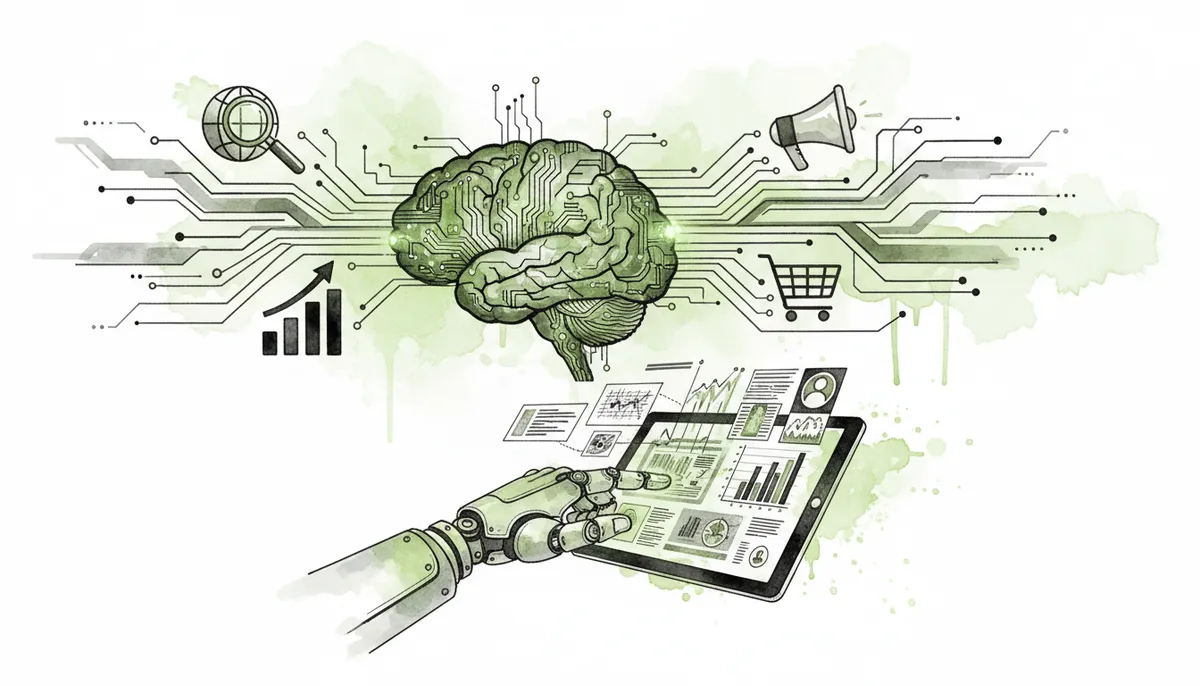
As we navigate 2026, the landscape of digital marketing is undergoing a profound and permanent transformation, driven by advancements in artificial intelligence (AI). The integration of AI technologies into marketing strategies is no longer a futuristic concept but an absolute necessity for businesses of all sizes striving to compete in an increasingly crowded digital marketplace. AI offers innovative solutions that enhance customer engagement, streamline operations, and provide invaluable, real-time insights into consumer behavior.
For businesses, leveraging AI is the difference between thriving and merely surviving in a digital-first world. The importance of AI in digital marketing cannot be overstated. With the ability to analyze vast datasets with superhuman speed and accuracy, AI empowers marketers to make informed decisions that resonate deeply with their target audience. These capabilities are central to the most crucial digital marketing tips for 2026 for any modern business.
From dynamically personalized customer journeys to predictive analytics that forecast market trends, AI is fundamentally reshaping how brands interact with consumers. It is the engine behind the most effective campaigns and the brain behind data-driven strategy. As we delve deeper into the various facets of AI in digital marketing, it becomes clear that embracing these technologies is essential for enhancing marketing efforts and driving sustainable growth in 2026 and beyond.
- Hyper-Personalized Customer Experiences
- AI-Powered Content Creation and Optimization
- Predictive Analytics and Decision Making
- Voice Search and Conversational AI
- AI-Powered Advertising and Targeting
- Automation and Efficiency in Digital Marketing
- Ethical Considerations and Challenges of AI in Digital Marketing
- FAQ
- Frequently Asked Questions
- Sources
Table of Contents
- Key Takeaways
- Hyper-Personalized Customer Experiences
- AI-Powered Content Creation and Optimization
- Predictive Analytics and Decision Making
- Voice Search and Conversational AI
- AI-Powered Advertising and Targeting
- Automation and Efficiency in Digital Marketing
- Ethical Considerations and Challenges of AI in Digital Marketing
- FAQ
- Sources
Key Takeaways
- AI is revolutionizing digital marketing by enabling hyper-personalized customer experiences, automated content creation, predictive analytics, and highly targeted advertising.
- Personalization in 2026 goes beyond product recommendations to include entire dynamic user journeys, tailored in real-time based on user behavior and first-party data.
- Generative AI tools are now standard for creating and optimizing multimodal content (text, images, video), helping marketers improve SEO, engagement, and efficiency.
- Predictive analytics leverages AI to analyze vast datasets and forecast future trends, enabling marketers to make proactive, data-driven decisions on everything from customer churn to inventory.
- Voice search and conversational AI are central to customer interaction, requiring strategies optimized for natural language queries and AI-driven chatbots that function as sophisticated brand agents.
- Ethical use of AI, particularly concerning data privacy, algorithmic transparency, and bias, is a critical component of a sustainable and trustworthy marketing strategy in 2026.
Hyper-Personalized Customer Experiences
One of the most significant advantages of AI in digital marketing is its ability to create hyper-personalized customer experiences at scale. In an era where consumers are inundated with generic messaging, personalization has emerged as a key differentiator. AI algorithms analyze user data—browsing history, purchase behavior, real-time engagement, and demographic information—to tailor marketing messages and product recommendations to individual preferences with unprecedented accuracy.
This level of personalization not only enhances customer satisfaction but also fosters profound brand loyalty. For instance, an e-commerce platform using an AI-driven personalization engine like Dynamic Yield can do more than suggest products. In 2026, it dynamically alters the website layout, promotional offers, and content for each unique visitor, creating a truly one-to-one journey. This is powered by sophisticated Customer Data Platforms (CDPs) that unify first-party data, which has become critical since the deprecation of third-party cookies.
This proactive tailoring not only increases conversion rates by as much as 20% but also creates a more intuitive and enjoyable shopping experience for the customer.
Furthermore, personalized email and push notification campaigns powered by AI can significantly improve engagement rates. These systems can predict the optimal time to send a message to an individual user and even generate unique subject lines tailored to their past interactions, ensuring content speaks directly to their immediate needs and interests.
AI-Powered Content Creation and Optimization
Content remains king in the digital marketing realm, and AI is revolutionizing how businesses strategize, create, and optimize it. With tools that can generate high-quality written, visual, and even video content, analyze keyword performance, and suggest optimal posting times, AI is streamlining the entire content lifecycle. This allows marketers to shift their focus from tedious production tasks to high-level strategy and creativity, acting as editors and curators of AI-generated drafts.
Platforms powered by advanced generative AI models from leaders like OpenAI now assist marketers in generating blog posts, social media updates, video scripts, and ad copy with minimal human intervention. This shift has been pivotal, and knowing how to use AI for content creation is now a core marketing skill. Beyond creation, AI tools are essential for SEO, analyzing SERPs in real-time, identifying content gaps, and predicting a headline’s performance before publication. The rise of generative AI in SEO has made content optimization a more precise and data-driven science, enabling brands to rank for complex, long-tail queries with greater efficiency.
Predictive Analytics and Decision Making
Predictive analytics is another area where AI is making a substantial impact. By analyzing historical data and identifying patterns, AI algorithms can forecast future trends, customer behavior, and market shifts with a high degree of accuracy. The global predictive analytics market is projected to surpass $50 billion in 2026, highlighting the massive investment businesses are making in data-driven forecasting.
This enables marketers to make proactive, data-driven decisions rather than relying on guesswork. For example, predictive analytics can help businesses identify customers at risk of churning by analyzing subtle changes in their engagement patterns, allowing them to implement targeted retention strategies before the customer leaves. It can also optimize pricing strategies in real-time based on demand, forecast product demand to prevent stockouts, and personalize marketing campaigns for maximum effectiveness. Platforms like Salesforce Einstein AI lead the charge in integrating these capabilities directly into CRM systems, making predictive insights accessible across the entire organization.
Voice Search and Conversational AI
The proliferation of voice assistants and smart speakers has fundamentally changed how consumers search for information and interact with brands. By 2026, it’s estimated that there will be over 9 billion digital voice assistants in use worldwide, making voice search optimization a non-negotiable aspect of any modern SEO strategy. Marketers must optimize content for natural language, long-tail keywords, and question-based queries to appear in voice search results.
AI-powered conversational agents, or chatbots, have also become indispensable tools for customer engagement. The AI chatbots of 2026 are far more advanced than their predecessors; they handle complex, multi-turn customer service inquiries, qualify leads, schedule appointments, and integrate seamlessly with CRM systems. These systems are evolving into autonomous AI agents that can execute multi-step tasks, providing a continuous and personalized user experience 24/7 without the need for human intervention for routine requests.
AI-Powered Advertising and Targeting
AI has transformed the world of digital advertising, making it more efficient, effective, and accountable than ever before. AI algorithms analyze trillions of data points in milliseconds to identify the most relevant audience for a particular ad campaign, ensuring that marketing messages reach the right people at the right time. Projections for 2026 indicate that AI will influence over 90% of all digital advertising spend, optimizing everything from audience segmentation to real-time bidding on programmatic platforms.
This level of precision targeting, powered by tools like Google’s AI for Ads, not only improves campaign performance but also optimizes ad spend by minimizing waste. AI can also automate A/B testing of ad creatives, headlines, and calls-to-action on a massive scale, continuously learning and optimizing for the best results. This process, known as Dynamic Creative Optimization (DCO), leads to a higher return on ad spend (ROAS) and a significant reduction in budget spent on irrelevant audiences.
Automation and Efficiency in Digital Marketing
Automation is a cornerstone benefit of AI, freeing up marketers from repetitive and time-consuming tasks. Studies now suggest that marketing teams leveraging the best AI marketing tools for 2026 can achieve up to a 40% increase in productivity and lead quality.
From email marketing and social media scheduling to complex data analysis and reporting, AI can automate a wide range of marketing activities. For example, AI can manage a social media marketing strategy by not only scheduling posts but also generating caption variations, suggesting relevant hashtags, and analyzing audience sentiment in real-time. This allows marketing teams to focus their efforts on strategic planning, creative development, and building meaningful customer relationships, letting the machine handle the mechanics of execution.
Ethical Considerations and Challenges of AI in Digital Marketing
As AI’s role in marketing deepens, so do the ethical considerations. In 2026, navigating data privacy is paramount. With the complete phase-out of third-party cookies, marketers are now reliant on first-party data strategies that demand transparency and trust. Businesses must be explicit about how they use customer data and ensure their AI models are free from biases that could lead to unfair or discriminatory outcomes. Regulations like GDPR and CCPA are no longer just compliance checkboxes but the foundation of customer trust.
Striking the right balance between AI-driven efficiency and genuine human connection remains a key challenge. Customers still value authenticity and a human touch, and over-automation can feel impersonal. The most successful brands in 2026 use AI as a tool to enhance, not replace, the human element in their marketing efforts. For business leaders, the strategic and ethical application of these technologies is central to understanding the full scope of AI’s impact on marketing and harnessing it for sustainable, responsible growth.
FAQ
What is AI’s biggest impact on digital marketing?
AI’s biggest impact is enabling true one-to-one personalization at scale. It allows brands to analyze vast amounts of customer data in real-time to deliver unique experiences, from tailored website content to predictive product recommendations, that were previously impossible to execute.
How does AI help with content creation?
AI helps by automating and optimizing the content lifecycle. Generative AI tools can draft articles, social media posts, and ad copy, while other AI systems can analyze data to suggest topics, optimize for SEO, and predict which headlines will perform best, freeing up marketers to focus on strategy.
Can small businesses use AI in marketing?
Absolutely. In 2026, AI marketing tools are more accessible and affordable than ever. Many SaaS platforms for email, social media, and SEO have built-in AI features, allowing small businesses to leverage powerful automation and analytics without needing a dedicated data science team.
Is AI going to replace digital marketers?
AI is not replacing marketers but rather augmenting their capabilities. It automates repetitive tasks and provides deep data insights, allowing marketers to transition into more strategic roles focused on creativity, brand strategy, and managing the human-AI collaboration.
What are the ethical risks of using AI in marketing?
The primary ethical risks involve data privacy and algorithmic bias. Marketers must be transparent about data collection and usage, and they need to ensure their AI models do not perpetuate unfair biases that could lead to discriminatory advertising or customer treatment.
How does predictive analytics improve marketing ROI?
Predictive analytics improves ROI by enabling proactive decision-making. It helps identify high-value leads, predict customer churn to implement retention strategies, and optimize ad spend by focusing on audiences most likely to convert, thereby reducing waste and increasing efficiency.
Frequently Asked Questions
How does hyper-personalized customer experiences actually work?
The section on “Hyper-Personalized Customer Experiences” above breaks this down with specific examples and data. Jump to that section for the full treatment.
How does ai-powered content creation and optimization actually work?
The section on “AI-Powered Content Creation and Optimization” above breaks this down with specific examples and data. Jump to that section for the full treatment.
How does predictive analytics and decision making actually work?
The section on “Predictive Analytics and Decision Making” above breaks this down with specific examples and data. Jump to that section for the full treatment.
Sources
- Dynamic Yield by Mastercard — A leading AI-powered personalization and experience optimization platform.
- OpenAI — The research and deployment company behind advanced generative models like GPT-4 and its successors.
- Salesforce Einstein AI — Documentation on AI integration within the Salesforce CRM ecosystem.
- Google AI for Ads — Official resource on how Google uses AI to power its advertising platforms.
- Statista — A leading provider of market and consumer data, used for market size and technology usage projections.
- Gartner for Marketers — Research and advisory firm providing insights on marketing technology trends, including AI.
- EU Commission on GDPR — Official information on the General Data Protection Regulation (GDPR).