
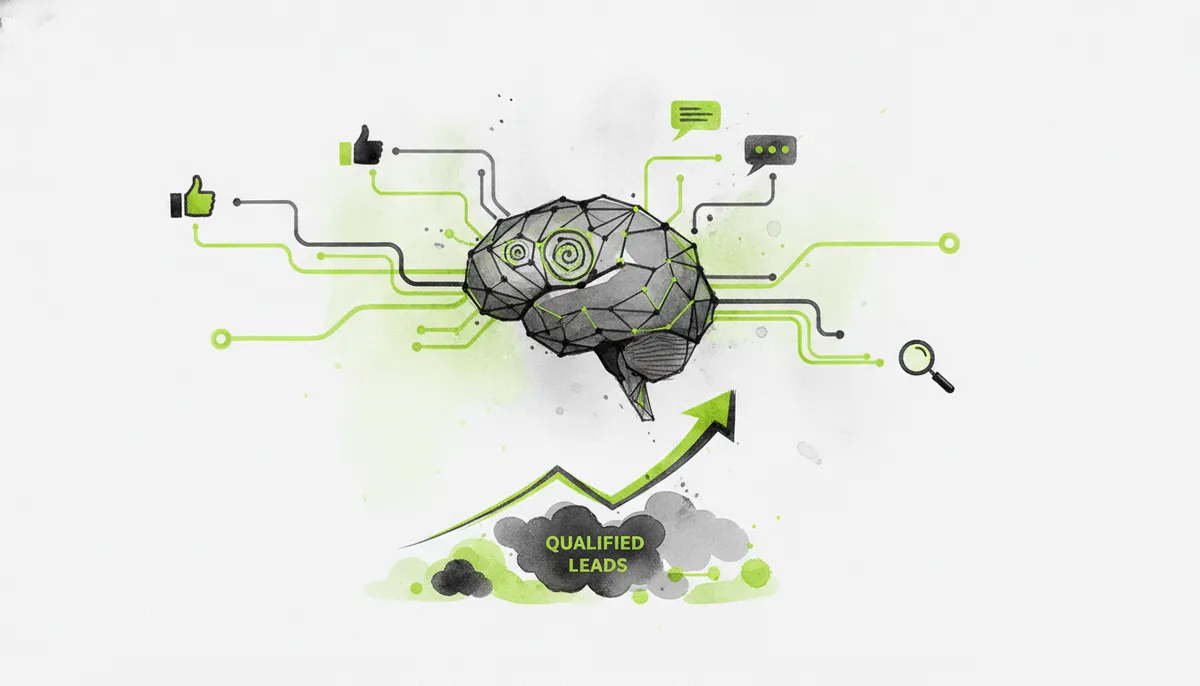
An effective strategy social media marketing for B2B SaaS in 2026 is a fully integrated, AI-driven system designed to generate qualified leads and directly impact revenue. It moves beyond vanity metrics by using AI for predictive audience modeling, creating data-driven content that aligns with sales goals, and leveraging smart automation to scale personalized outreach, transforming social media from a cost center into a core component of your go-to-market engine.
- Introduction: Why Your 2025 Social Media Playbook Is Already Obsolete
- Pillar 1: AI-Powered Intelligence & Audience Definition
- Pillar 2: A Data-Driven Content Engine for a Winning Strategy Social Media Marketing
- Pillar 3: Automated Outreach & Community Engagement
- Comparing Social Media Marketing Approaches for SaaS
- Frequently Asked Questions
- Which social media platform is best for a B2B SaaS company in 2026?
- How much should a B2B SaaS founder budget for their social media marketing strategy?
- Can AI completely replace my social media manager?
- How long does it take to see tangible results (leads, demos) from a new social media strategy?
- How does a strong social media strategy impact my company’s SEO?
- What is the single biggest mistake SaaS companies make on social media?
- Sources & Further Reading
Key Takeaways: Your 2026 Social Media Strategy at a Glance
- AI is Non-Negotiable: AI-driven audience analysis, content generation, and performance prediction are the new baseline for competitive SaaS marketing.
- Focus on High-Value Platforms: Identify and dominate the 1-2 platforms where your Ideal Customer Profile (ICP) actively seeks solutions, primarily LinkedIn for B2B SaaS.
- Content as a Conversion Tool: Every piece of content must serve a strategic purpose—from building authority with technical deep-dives to driving demo requests with case studies.
- Automation Unlocks Scale: Strategic outreach automation is key to engaging potential buyers at scale without sacrificing personalization.
- Social Is a Core GTM Component: Your social strategy must integrate seamlessly with your SEO, email outreach, and sales processes to create a unified customer journey.
- Measure What Matters: Ditch follower counts for metrics that correlate to revenue: Marketing Qualified Leads (MQLs), Cost Per Acquisition (CPA), and pipeline influence.
Introduction: Why Your 2025 Social Media Playbook Is Already Obsolete
As a B2B SaaS founder, you’ve likely felt the frustration: you invest time and resources into social media, post consistently, and see engagement, but the impact on your bottom line remains a mystery. The likes and shares are there, but where are the demo requests? Where is the tangible impact on your Monthly Recurring Revenue (MRR)? This disconnect is the defining failure of traditional social media marketing. This guide outlines a new approach to building a strategy social media marketing system for 2026.
The Shift from Vanity Metrics to Revenue Engine
In 2026, a successful social media marketing strategy is not a content calendar; it’s a fully integrated, AI-driven system designed to generate qualified leads and directly impact revenue. It’s about treating social media with the same analytical rigor as your product development or sales pipeline. The goal is no longer just to be present; it’s to build a predictable engine for growth.
Our philosophy is that every marketing action should be measurable, scalable, and directly tied to business outcomes.
Pillar 1: AI-Powered Intelligence & Audience Definition
The foundation of any successful marketing strategy is a deep, accurate understanding of the customer. Traditional methods relied on static, assumption-based personas that quickly became outdated. In 2026, AI allows us to move from guesswork to data-driven prediction, ensuring every piece of content and outreach message resonates with your ideal buyer.
Moving Beyond Personas to Predictive ICP Modeling
Static buyer personas—often created in a workshop and then forgotten in a shared drive—are no longer sufficient. They capture a snapshot in time, missing the dynamic nature of your buyers’ needs, challenges, and online behavior.
An AI-powered approach builds a dynamic, predictive Ideal Customer Profile (ICP). We use sophisticated tools to analyze real-time social data from platforms like LinkedIn, discussions in niche Reddit communities, and competitor audience engagement. This reveals not just demographics but the precise language your prospects use to describe their pain points, the buying triggers that motivate them, and the content formats they trust.
The vast majority of their journey is independent research online, much of which happens on social and community platforms. An AI-powered ICP model allows you to meet them there with the right message before they ever think to contact a sales rep.
Strategic Platform Selection: Where to Invest Your Resources
The “be everywhere” approach is a recipe for burnout and diluted impact. For B2B SaaS, focus is your greatest asset. An AI-driven analysis of your ICP will pinpoint the exact digital locations where your buyers are most active and receptive.
- LinkedIn (Primary): For nearly all B2B SaaS companies, LinkedIn is the epicenter. It’s not just a platform for posting updates; it’s a powerful database for prospecting with Sales Navigator, a hub for industry-specific groups where real business problems are discussed, and the ideal stage for building the founder’s personal brand as a thought leader.
- Twitter/X (Secondary): If your ICP consists of tech executives, developers, or VCs, Twitter/X is invaluable for real-time conversations, trend-spotting, and direct engagement with industry influencers.
- Niche Communities (Tertiary): Don’t overlook platforms like Reddit (e.g., r/sysadmin, r/saas) or industry-specific Slack channels. These are high-signal environments where technical buyers ask candid questions and seek peer recommendations. AI-powered social listening can identify these opportunities at scale.
- YouTube (Content Hub): For complex products, YouTube serves as a powerful middle-of-funnel platform for in-depth tutorials, product demos, and webinar recordings that build trust and demonstrate value.
Pillar 2: A Data-Driven Content Engine for a Winning Strategy Social Media Marketing
Content is the fuel for your social media engine, but creating it without a clear system is inefficient and ineffective. A modern strategy social media marketing requires a content engine that is scalable, data-driven, and seamlessly integrated with your broader SEO and sales goals.
Content Strategy That Aligns with SEO and Sales
Your social media content should not exist in a vacuum. It must be an extension of your core marketing strategy, designed to attract, educate, and convert your ICP.
- Use SEO to Inform Social: Your SEO keyword research from tools like Ahrefs or SEMrush is a goldmine of content ideas. If prospects are searching for “how to reduce customer churn with AI,” that exact topic should become a blog post, a LinkedIn carousel, a series of tweets, and a short video clip. This creates a cohesive user journey from search to social.
- Map Content to the Buyer’s Journey: Structure your content to guide prospects from awareness to decision.
- Top-of-Funnel (ToFu): Problem-aware, educational content like blog posts, infographics, and short-form videos that address your ICP’s primary pain points.
- Middle-of-Funnel (MoFu): Solution-aware content that builds trust and showcases your expertise, such as webinar clips, detailed case studies, and downloadable whitepapers.
- Bottom-of-Funnel (BoFu): Decision-stage content designed to drive action, including customer testimonials, product demo videos, and direct offers for a consultation.
- Repurpose Everything: A single one-hour webinar can be repurposed into dozens of social media assets. This “create once, distribute forever” model maximizes the ROI on your content creation efforts. Extract key quotes for text posts, create short video clips of key moments, turn slides into a LinkedIn carousel, and transcribe the audio for a blog post.
Leveraging Generative AI and Model Context Protocol (MCP)
Generative AI is more than a tool for writing post captions; it’s a strategic co-pilot for your entire content engine. However, generic AI prompts yield generic results. The key to unlocking its power is providing deep, persistent context.
This is where Model Context Protocol (MCP) comes in.
Model Context Protocol (MCP) is an open standard that allows you to provide a generative AI with a persistent “briefing” or set of instructions. This context includes your brand voice guidelines, detailed ICP data, product specifications, key value propositions, and strategic goals.
By using MCP, you ensure that every content draft the AI generates is already on-brand, factually accurate, and strategically aligned. The workflow becomes incredibly efficient:
- Ideation: AI analyzes performance data and suggests new content angles that are likely to resonate.
- Drafting: The AI, armed with MCP, generates a high-quality first draft of a blog post, LinkedIn article, or social media caption.
- Refinement: A human strategist reviews, refines, and adds the final layer of nuance and authenticity before publishing.
This system dramatically increases content velocity without sacrificing quality, allowing a small team to perform like a much larger one.
Struggling with content velocity? If your team is finding it difficult to produce high-quality, on-brand content at the pace the market demands, an AI-powered content engine can be a game-changer. See how our AI consultancy services can build a system tailored to your needs.
Pillar 3: Automated Outreach & Community Engagement
Content builds your brand, but proactive engagement and outreach are what fill your sales pipeline. In 2026, the challenge is to do this at scale without resorting to spammy, impersonal tactics that damage your reputation. The solution lies in smart, strategic automation paired with authentic human interaction.
Scaling Founder Presence and Thought Leadership
For a B2B SaaS company, the founder’s personal brand is one of its most powerful marketing assets. Buyers trust people more than they trust logos. However, founders are notoriously time-poor. An AI-powered system can scale their presence without consuming their schedule.
The process is simple: a content team or consultant interviews the founder for one hour per week, discussing industry trends, customer challenges, and company vision. This raw material is then transformed:
- Ghostwritten Content: The interview is used to ghostwrite dozens of insightful LinkedIn posts, Twitter threads, and blog articles in the founder’s authentic voice.
- Targeted Engagement: Social listening tools identify high-impact conversations where the founder’s expertise would be valuable. The team drafts a thoughtful comment, and the founder simply has to approve and post it.
This system allows a founder to build a powerful thought leadership presence in just a few hours a month, establishing trust and attracting inbound leads for their business.
Comparing Social Media Marketing Approaches for SaaS
Choosing the right operational model for your social media is a critical strategic decision. The traditional options of hiring an agency or building an in-house team are now being challenged by a more efficient, AI-powered system-based approach.
Calculating the True ROI of an AI-Driven Strategy
To understand the value, B2B SaaS founders must move beyond simple cost comparisons and calculate the true ROI. A simple framework is:
ROI = (Value of New Pipeline + Lifetime Value of Customers from Social – Cost of Service) / Cost of Service
Contrast this with the hidden costs of the traditional approach: full-time salaries north of $80,000 per marketing hire, expensive subscriptions for multiple disparate tools (scheduling, listening, analytics), and the significant opportunity cost of slow, manual processes that fail to capture leads effectively.
This reclaimed time allows your team to focus on high-value strategic work instead of manual execution, dramatically improving efficiency and ROI.
Frequently Asked Questions
Which social media platform is best for a B2B SaaS company in 2026?
For nearly all B2B SaaS companies, LinkedIn is the primary platform due to its professional context, powerful targeting capabilities, and user mindset geared toward business solutions. However, a thorough, AI-driven audience analysis might reveal high-value, niche communities on platforms like Reddit, Twitter/X, or industry-specific forums that should not be ignored.
How much should a B2B SaaS founder budget for their social media marketing strategy?
Instead of a fixed amount, think in terms of customer acquisition cost (CAC). A successful strategy’s budget should be a fraction of the lifetime value (LTV) of the customers it acquires. Early-stage startups may invest more heavily in sweat equity, while growth-stage companies might allocate 10-20% of their marketing budget to a combined content and social strategy.
Can AI completely replace my social media manager?
No. AI automates repetitive, data-intensive tasks and provides powerful insights, elevating the social media manager from a content publisher to a true strategist. The human element remains crucial for final content approval, authentic community engagement, high-level strategy decisions, and building genuine relationships.
How long does it take to see tangible results (leads, demos) from a new social media strategy?
While brand awareness metrics like engagement and follower growth can improve within weeks, seeing a consistent flow of qualified leads typically takes 3-6 months. This timeline allows for building authority, gathering data to refine messaging, and nurturing relationships with potential buyers through the sales cycle.
How does a strong social media strategy impact my company’s SEO?
It impacts SEO in several key ways. First, it drives traffic to your SEO-optimized blog content. Second, high-quality social posts that get shared can generate valuable backlinks. Third, strong and active social profiles rank in search results for your brand name, helping you dominate your brand’s SERP. Finally, social signals can indirectly indicate content quality and authority to search engines.
What is the single biggest mistake SaaS companies make on social media?
The biggest mistake is inconsistent, self-promotional posting with no clear strategy or connection to business goals. They broadcast product features instead of addressing their customers’ problems, fail to engage in meaningful conversations, and don’t measure the impact of their efforts on leads, pipeline, and revenue.
Sources & Further Reading
- The 2026 B2B Content Marketing Benchmarks, Budgets, and Trends — Insights from the Content Marketing Institute on industry trends.
- LinkedIn’s Sophisticated Marketer’s Guide — Resources and best practices directly from LinkedIn for B2B marketers.
- How Generative AI Is Changing Marketing and Sales — A McKinsey report on the transformative impact of AI on marketing functions.
- How Social Media Can Help (or Hurt) Your SEO — An in-depth guide from Ahrefs on the relationship between social media and search engine optimization.
- Gartner for Marketers — Research and data on B2B buyer behavior and marketing technology trends.
Have a similar challenge? Explore our services.
Related in this topic
- The 7-Step B2B Social Media Marketing Strategy for SaaS Founders (2026 Guide)
- What is a Social Media Marketing Strategy? 10 Essential Steps for B2B SaaS Growth in 2026
- The Ultimate B2B Social Media Marketing Strategy for SaaS Founders (2026 Guide)
- The Definitive Marketing Strategy for Social Media: An AI-Powered Framework for SaaS in 2026
- Social Media Marketing Strategy Guide: 7 Proven Steps for B2B SaaS Growth (2026)
- 9 Steps to the Best Social Media Marketing Strategy for B2B SaaS in 2026